How to Manage Sports Card Consignments Without the Chaos
Running consignments for other collectors is a great business, until you have 4 consignors, 200 cards, and a spreadsheet that breaks every week. Here's the right way to do it.
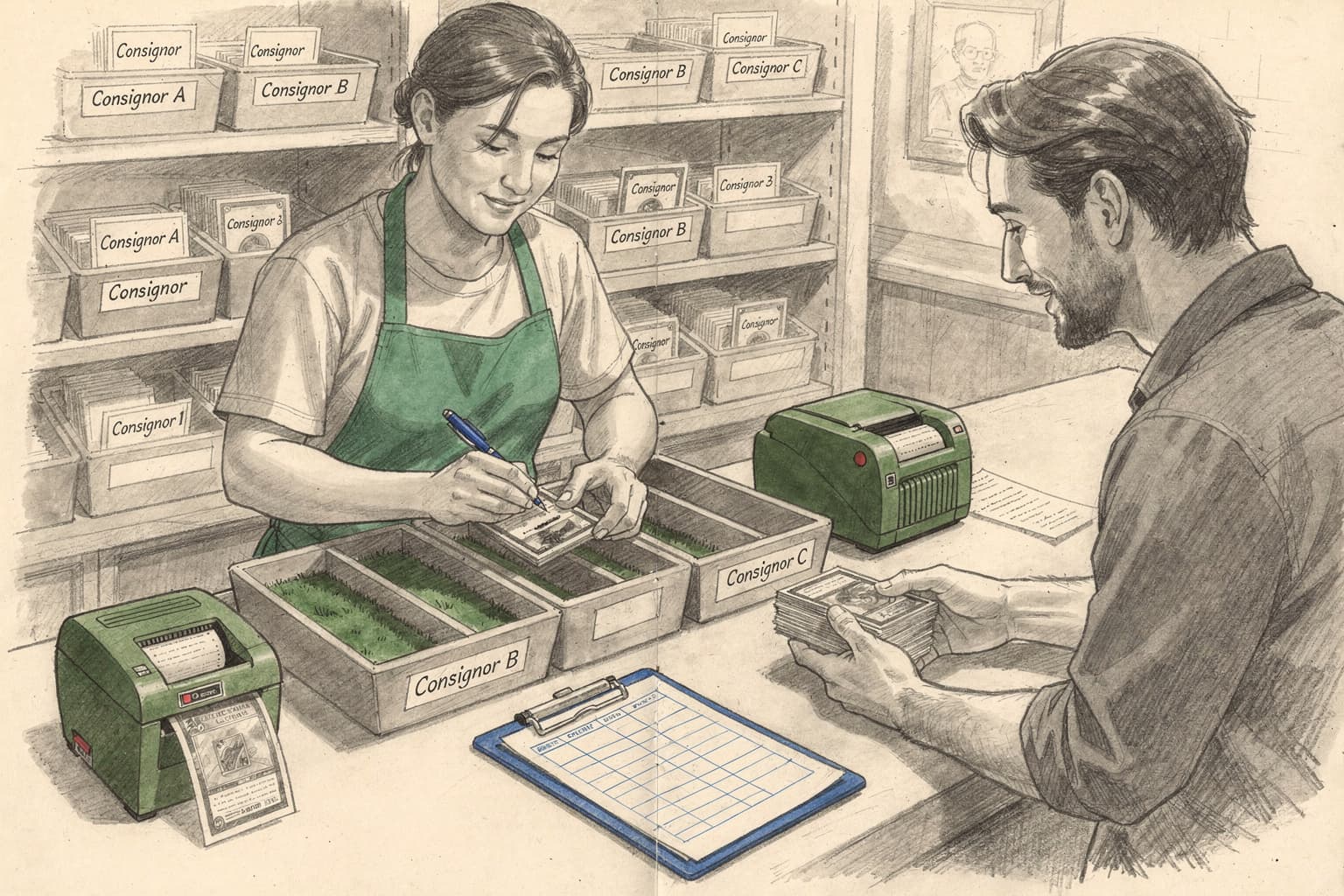
Sports card consignment is one of the most profitable side businesses in the hobby. You sell other people's cards, take a cut, and your own capital isn't at risk. But once you have more than one or two consignment relationships, the operational complexity grows fast.
Here's how to run consignments professionally, and what most dealers get wrong.
The Three Things That Go Wrong with Consignments
1. Losing track of who owns what. When you have 200 consignment cards across 5 consignors, mixed with your own inventory, the risk of accidentally selling someone else's card at the wrong price, or for your own benefit, is real. Most dealers don't have this problem intentionally. They have it because their tracking system can't keep up.
2. Disputes about what sold and at what price. "I sold your Jordan for $200." "I thought it was worth $250, why didn't you hold out?" If you don't have a record of the agreed price and the actual sale price, you're in a he-said-she-said situation that damages relationships and your reputation.
3. Slow payouts and unclear accounting. Consignors want to know what sold, what's still available, and what they're owed. If you can't produce a clean statement on demand, you look disorganized even if you're honest. The best consignment dealers pay out quickly and proactively, it builds trust and gets you more inventory.
Setting Up a Consignment Agreement
Before you take a single card, you need a clear agreement that covers:
Commission rate. Most dealers charge 20–30% for individual cards, lower (10–15%) for bulk lots. Higher-value cards sometimes have negotiated rates. Be consistent and document it.
Minimum prices. Each card should have a floor, the minimum price at which you'll sell. Selling below floor without consignor approval is how disputes start. Document the floor at intake, and get explicit approval before you discount.
Payout timing. Weekly, biweekly, monthly? Pick a cadence and stick to it. Inconsistent payouts are the fastest way to lose consignors to dealers who pay reliably.
Platform fees. eBay, Whatnot, PWCC, they all charge fees. Who absorbs those? Typically the fee comes out before your commission is calculated, so both parties share it proportionally. Make sure the consignor understands this upfront.
Duration. How long will you try to sell the card before returning it? 60–90 days is common. Establish a return process so inventory doesn't sit indefinitely.
Tracking the Inventory
The intake process is where most consignment operations fall apart. If you don't document cards correctly when you receive them, everything downstream gets messy.
At intake, record:
- Card identity (player, year, set, variation, grade/grader if slabbed)
- Condition notes for raw cards (corners, surface, centering)
- Agreed minimum price
- Consignor name and contact info
- Intake date
- Where you plan to list it (eBay, your storefront, at shows, etc.)
A photo at intake is worth the extra 30 seconds. If a consignor disputes a condition issue later, you have evidence.
The critical rule: Consignment inventory must be physically and logically separated from your own. If it's in the same box as your cards, tagged identically, you're setting yourself up for a mistake.
Recording Sales and Tracking Payouts
Every sale creates an obligation. Record:
- Card sold
- Sale date
- Platform/venue
- Sale price
- Platform fee (if applicable)
- Your commission
- Net to consignor
From these records, generating a payout statement is simple math. Without them, every payout requires reconstruction, which is slow, error-prone, and looks bad.
Payout statements should show every card you received, what sold and when, what didn't sell and where it stands, and the total owed. A clean statement takes a few minutes to produce if your records are current. It takes hours if they're not.
How Slabfy Handles Consignments
We built the Consignments feature because spreadsheets can't keep pace with a real consignment operation.
Every card you take on consignment lives in Slabfy as a consignment asset tied to a specific consignor. Your own inventory is completely separate. When you sell a consignment card, at a show, through your storefront, or anywhere else, the sale records against the consignment automatically, and Slabfy calculates what's owed.
At any point you can pull a full statement for any consignor: what you have, what sold, what you owe. Payouts and history are tracked. The operational overhead drops to almost zero.
Ask Slabfy can also answer questions like "What do I owe Smith right now?" or "Which consignment cards are still unsold after 60 days?" without you digging through records.
Building Long-Term Consignment Relationships
The dealers who consistently get the best consignment inventory aren't necessarily the ones with the best reach or biggest shows. They're the ones who are reliable.
Pay on time, every time. This is the most important thing. Consignors who trust you to pay reliably will give you their best cards. Inconsistency makes you a last resort.
Communicate proactively. If a card isn't moving, tell the consignor before they ask. Offer options: drop the price, return the card, or hold it for an upcoming show. Letting cards sit silently for months without communication is a relationship killer.
Return unsold cards efficiently. When the consignment period ends, a fast, organized return process impresses people more than you'd expect. It signals that you run a real operation.
The best consignment dealers in the hobby aren't just good at sales, they're good at running the business side. That's the part where good systems pay off.
Explore Slabfy consignment management, included with the Dealer plan and above. See current plans.