How to Price Sports Cards at a Card Show (Without Getting Burned)
The honest breakdown of how serious dealers price cards quickly and accurately at shows, and why most collectors leave money on the table.
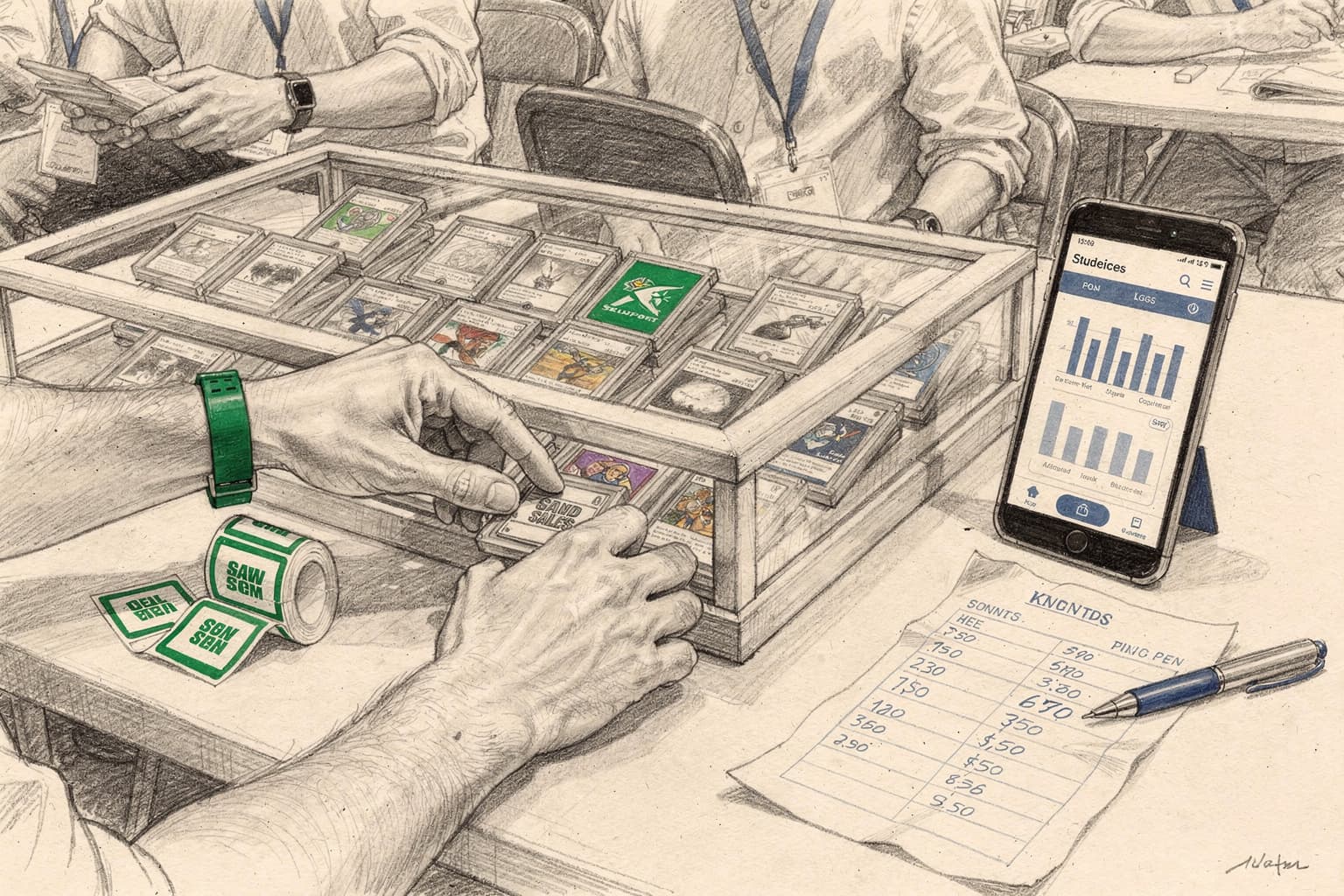
Pricing cards at a show is one of the highest-stakes skills in the hobby. You have seconds. The seller is watching. Other buyers are hovering. And the difference between a great flip and a bad beat is often just a few points of context you didn't have in time.
Here's how serious dealers actually do it, and where most people go wrong.
The Four Numbers You Actually Need
Most dealers think pricing a card means "check recent eBay sales." That's a starting point, not a method. The four numbers that actually tell you whether to pull the trigger are:
1. Raw price (current market) What is this card selling for ungraded, right now? Not 90 days ago. Not the list price on PWCC. What closed in the last 14 days on eBay, Whatnot, and Goldin. Recency matters, card markets move fast, especially off news cycles.
2. Graded value at PSA 9 and PSA 10 The raw price only tells you half the story. The real opportunity in most cards is the grading spread, the difference between what you pay for a raw card and what a PSA 9 or PSA 10 would sell for. A card that looks $20 raw becomes a $60 opportunity if it's a clean PSA 10 candidate.
3. Grading cost PSA's current tier pricing matters. A $25 grading submission on a card with a $30 PSA 10 premium is a break-even trade at best. A $25 submission on a $200 PSA 10 premium is a strong play. You can't evaluate a grading flip without knowing the cost.
4. Population report (pop) How many PSA 10s already exist for this card? A card with 10 PSA 10s and growing demand is different from one with 2,000 PSA 10s already in the market. High pop caps your upside. Low pop (especially for a player with rising heat) means scarcity premium.
The Spread, What You're Actually Buying
The spread is the gap between what you're paying and your best realistic exit. If you buy a card raw at $40 and the PSA 9 sells for $80, your spread is $40 minus grading costs. If PSA charges $25 and the card grades a 9 (which has a realistic probability if you know how to eye-grade), you're looking at $15 profit per card.
That sounds thin. It's not, if you can do it at volume and with accuracy.
Dealers who consistently beat the spread have two advantages:
- They know the grade on sight (can walk a card at 90%+ accuracy for the grades they target)
- They have pricing loaded instantly so they're calculating spread in their head while the seller is still talking
Why Most People Leave Money on the Table
The typical buyer at a show is reactive. They're looking at prices, not spread. They're checking eBay comps on their phone while the seller watches, which signals hesitation and eliminates negotiating leverage. And they're making decisions one card at a time instead of thinking about which cards are systematically undervalued in this seller's inventory.
Experienced dealers flip this. They walk a table looking for the three specific patterns where sellers consistently underprice:
- Raw cards for popular players in sets the seller doesn't know well (Pokémon dealers often underprice obscure sports sets and vice versa)
- Older raw cards that are PSA 10 candidates: sellers price off recent comps, but old cards in gem mint condition are rare and command premiums that newer comps don't reflect
- Lot pricing: many sellers price individual cards but will discount heavily on a lot buy, especially late in the show when they don't want to pack up
How Slabfy's Price Check Works
We built Price Check because manually looking up four numbers per card while someone's waiting on you is slow, mistake-prone, and kills your negotiating posture.
Scan the card. Slabfy pulls live sales data, calculates the grade ladder (your value at Raw, PSA 7, 8, 9, and 10 with grading costs already factored in), runs a liquidity score, and gives you a BUY or PASS verdict, in a few seconds.
The goal is to let you evaluate significantly more cards per show than you could doing manual lookups, without the fatigue and time pressure that come from checking comps on your phone one by one.
The Bottom Line
Good show pricing isn't about knowing every card's value from memory. It's about having a fast, accurate system for calculating the four numbers that actually matter, and applying it consistently across dozens of decisions in a high-pressure environment.
The dealers who win at shows aren't smarter than everyone else. They're faster and more systematic.
Slabfy is live. Monthly Collector and Collector Plus are free for 14 days. Start here.