How to Track and Organize Your Sports Card Collection
A breakdown of the most popular sports card collection tracking tools, including TCDB, CollX, SportsCardPro, and spreadsheets, with honest takes on what works and what doesn't.
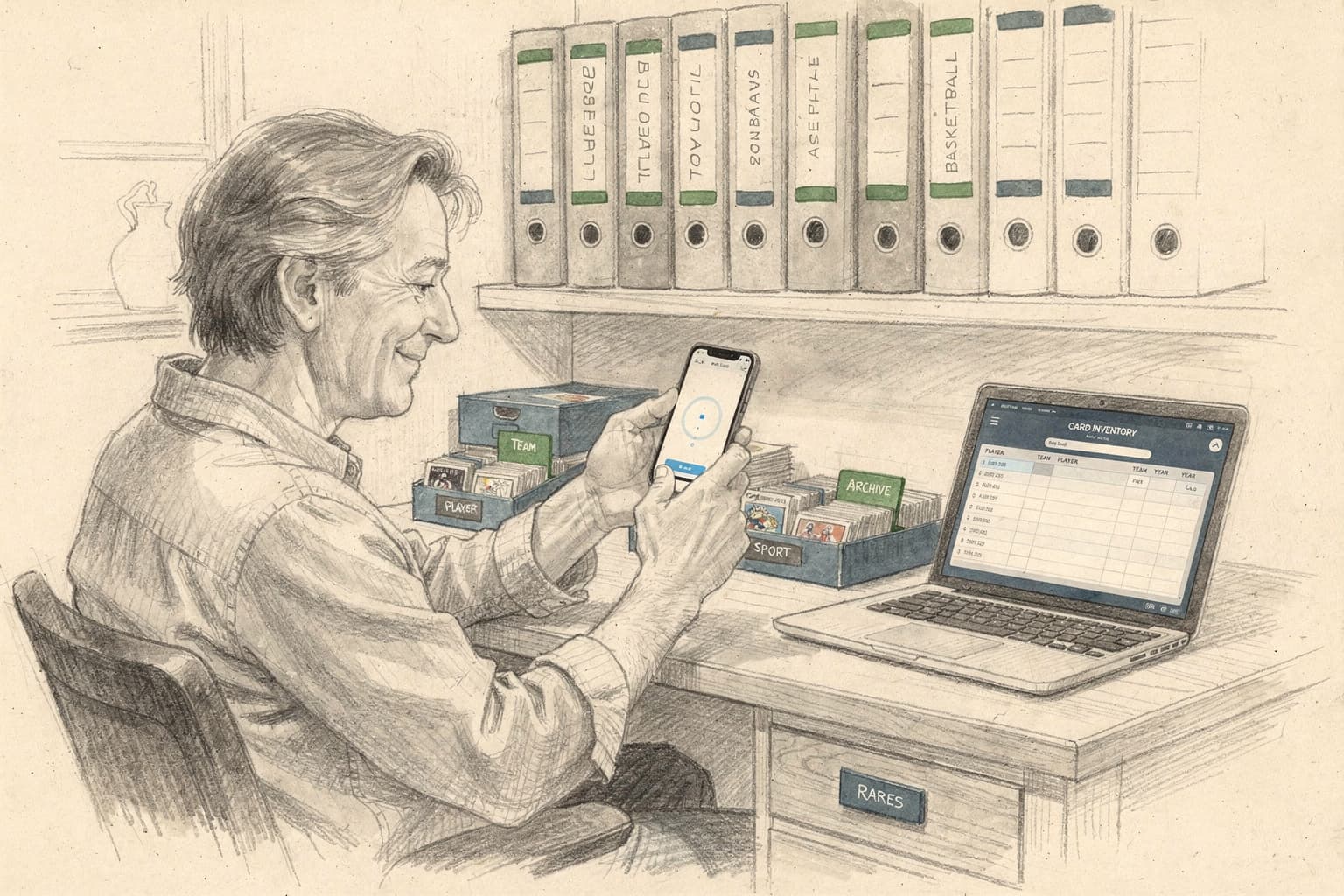
At some point, every collector hits the same wall: you can't remember what you have. Maybe it's a 5,000-count box in the closet, a stack of graded slabs on the shelf, or a pile of recent pickups that haven't been sorted yet. The longer you wait to organize, the harder it gets, and the more likely you are to buy duplicates, miss selling opportunities, or underestimate what your collection is actually worth.
Here's a real look at the tools people are using right now, what works, and what doesn't.
The Big Question: What Are You Tracking?
Before picking a tool, be clear about what you need:
- Inventory: A complete list of what you own.
- Valuation: What each card is worth today.
- Organization: What's in which box, binder, or sleeve.
- Set tracking: Which cards you need to complete a set.
- Profit/loss: What you paid vs. what you can sell for.
No single tool does all of these well. Most collectors end up using a combination.
TCDB (Trading Card Database)
What it is: A free, community-maintained database of cards across every sport, year, and manufacturer. The most comprehensive catalog in the hobby.
Best for: Set building and pure inventory tracking.
Why collectors love it:
- The database is massive. If a card exists, TCDB probably has it cataloged, including parallels, short prints, and insert sets.
- Set tracking is excellent. You can mark which cards you have and see exactly what you're missing to complete a set.
- It's free. No subscription, no premium tiers.
- The community maintains the data, which means coverage is surprisingly deep even for obscure or older sets.
The downsides:
- The interface looks dated. It works, but it's not modern or intuitive for new users.
- No real-time market valuations. TCDB tracks what things have sold for, but it's not a pricing tool.
- Mobile experience is functional but not great.
- Entering cards is manual. You'll be searching and clicking, not scanning.
Verdict: The gold standard for cataloging. If you're building sets or need a comprehensive checklist, start here.
CollX
What it is: A mobile-first card scanning app that identifies cards using your phone's camera and provides estimated values.
Best for: Quick identification and casual inventory of common cards.
Why collectors use it:
- The scanning feature is the main draw. Point your phone at a card and CollX tries to identify it and give you a value.
- It has a social/marketplace component, you can list cards for sale.
- The interface is modern and app-native.
The downsides:
- Valuations are widely considered unreliable. Across Reddit, the most common complaint is that CollX prices are "all over the place." Values can be significantly different from what cards actually sell for.
- The AI scanning struggles with parallels. If you have a base card, it'll probably get it right. A numbered parallel or refractor? It's a coin flip.
- Some features require a paid subscription (CollX Pro, around $10/month).
Verdict: Fine for getting a ballpark on common cards. Don't rely on it for pricing decisions. As one collector put it: "The AI for all of these is about the same... it's mostly just not there yet."
SportsCardPro
What it is: A database and valuation tool that pulls from eBay sold listings to provide market-based pricing.
Best for: Getting more accurate valuations than CollX.
Why collectors use it:
- Valuations are based on actual eBay sales data, which makes them more grounded in reality.
- Card scanning is available and reportedly improving.
- Clean interface with decent mobile support.
The downsides:
- The database isn't as deep as TCDB for obscure cards or older sets.
- Some features gated behind premium tiers.
- Still relies on AI scanning, which shares the same fundamental limitations as CollX for parallel identification.
Verdict: If valuation accuracy matters more than catalog depth, SportsCardPro is a step up from CollX. Still not perfect, but closer to real market values.
Card Ladder
What it is: A data analytics platform focused on graded cards, PSA, BGS, and SGC.
Best for: Tracking the value of your graded card portfolio over time.
Why collectors use it:
- Shows historical price charts for graded cards, similar to a stock portfolio tracker.
- Pulls from eBay and other sources for comp data.
- Good for monitoring trends and timing sales.
The downsides:
- Focused on graded cards. Not useful for raw card inventory.
- Premium features require a subscription.
- Less useful if you're a set builder or bulk collector.
Verdict: The best option specifically for graded card portfolio tracking. If you have a significant graded collection and want to know when values are trending up or down, Card Ladder delivers.
Google Sheets or Excel
What it is: A spreadsheet. Yes, seriously.
Best for: Complete control over exactly what you track and how.
Why collectors use it:
- You can track anything, purchase price, current value, location, grade, seller, date bought, whatever matters to you.
- No reliance on AI scanning or third-party valuations.
- No subscription fees.
- Completely customizable formulas for profit/loss calculations.
- Easy to share (Google Sheets) if you sell at shows or with partners.
The downsides:
- Manual data entry for every card. This is the dealbreaker for large collections.
- No automated valuations, you have to look up comps yourself.
- Doesn't scale well past a few hundred cards unless you're disciplined about data entry.
Verdict: Surprisingly popular among serious collectors and dealers. Multiple Reddit threads show experienced collectors recommending spreadsheets over apps because the data is always exactly right. The tradeoff is time.
130point.com
What it is: A free tool for checking eBay sold comps quickly.
Best for: Fast price checks on individual cards.
Why collectors use it: It's faster than navigating eBay's sold listings interface. Search for a card and see recent sales immediately.
The downside: It's a comp tool, not an inventory system. Use it alongside your tracking method of choice, not as a replacement.
The Honest Truth About Card Scanning
Every app that offers AI-powered card scanning makes the same promise: point your phone at a card and get an instant ID and value. Here's the reality in 2026:
It works okay for base cards. If you have a 2023 Topps Chrome base card, scanning will usually identify it correctly.
It falls apart for parallels, variations, and inserts. The difference between a base Prizm and a Silver Prizm is a subtle visual pattern. AI scanning hasn't reliably solved this yet across any platform, CollX, SportsCardPro, or anything else.
Non-US cards are poorly covered. If you collect international leagues, NPB, or anything outside the major US sports sets, scanning databases have significant gaps.
This isn't a knock on any specific app. The technology is improving, but it's not where it needs to be for collectors to fully trust automated identification.
What Most Collectors Actually Do
Based on community discussions, most serious collectors land on a combination:
- TCDB for comprehensive inventory and set tracking
- A spreadsheet for purchase/sale records and profit tracking
- 130point.com or eBay sold listings for current comps
- Card Ladder (optional) for watching graded card portfolio trends
Casual collectors who just want a rough idea of what they have tend toward CollX or SportsCardPro for the convenience of scanning, accepting that the values are approximate.
Where Slabfy Fits
Slabfy's inventory and collection tracking is built specifically for dealers, consigners, and serious collectors who need to know, not guess, what their cards are worth right now. It pulls real comp data, tracks your cost basis, and shows net margins after grading costs and fees.
If you're managing inventory for card shows, consignment clients, or a selling operation, Slabfy is built to be the single source of truth for your business.
Slabfy is live. Monthly Collector and Collector Plus are free for 14 days. Start here.