PSA vs BGS vs SGC: Which Grading Company Should You Use?
An honest comparison of the three major sports card grading companies, PSA, BGS, and SGC, covering cost, turnaround, resale value, and when each one makes the most sense.
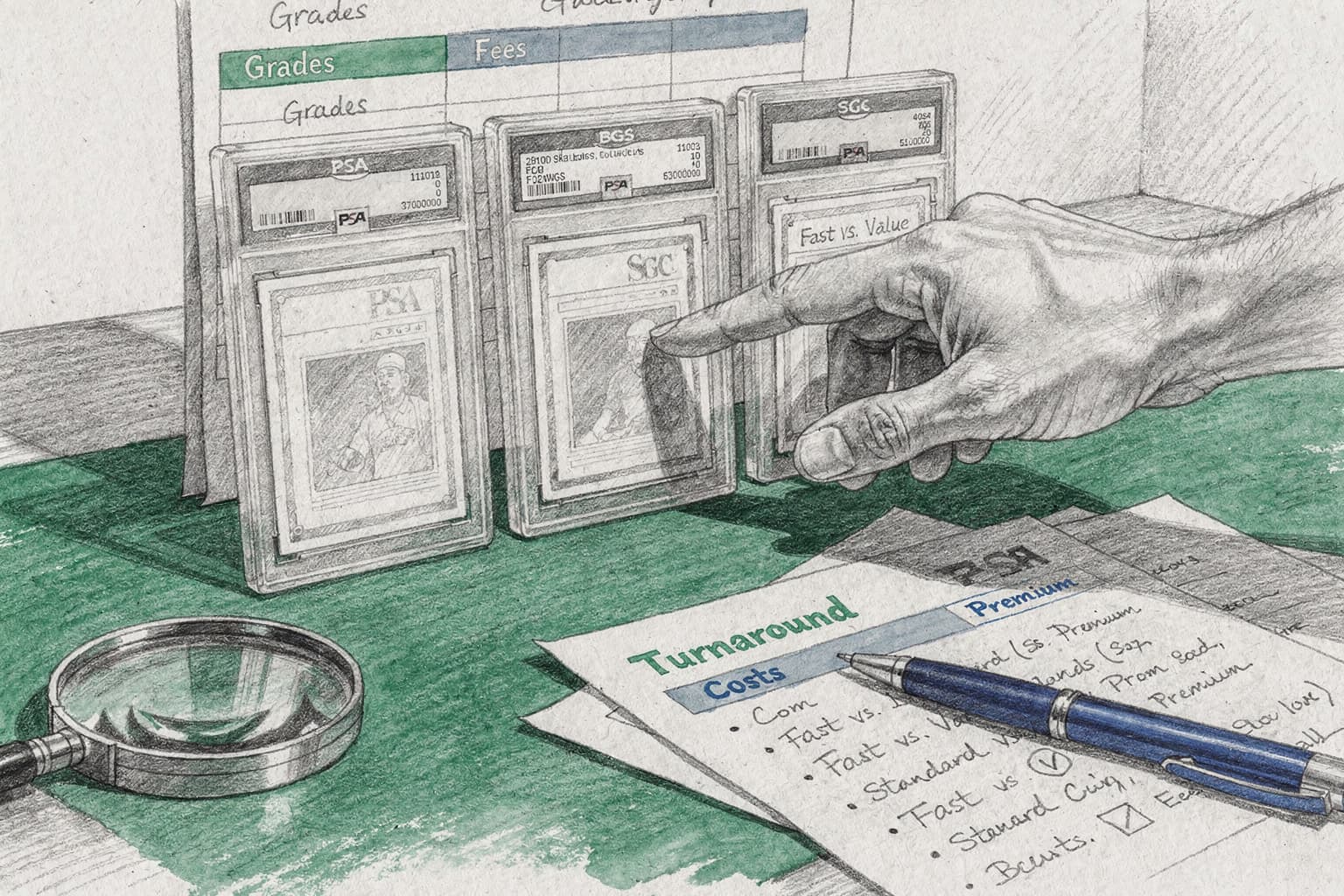
"Should I go PSA or SGC?" is one of the most asked questions in the hobby. The answer isn't the same for every card. Here's what actually matters when choosing a grading company, and why the right choice depends on what you're grading and what you plan to do with it.
The Three Major Grading Companies
PSA is the market leader with highest resale premiums, BGS offers sub-grades and the coveted Black Label 10, and SGC provides the fastest turnaround at the lowest cost.
PSA (Professional Sports Authenticator): The largest and most recognized grading company. Founded in 1991. Grades on a 1–10 scale. Dominates the modern card market and has the highest liquidity for most cards.
BGS (Beckett Grading Services): Known for sub-grades. Every BGS slab shows four category scores: centering, surface, corners, and edges. Grades on a 1–10 scale with half-point increments (9.5 is a critical tier). The "Black Label" pristine 10 is the highest achievable grade.
SGC (Sportscard Guaranty Company): The fastest-growing alternative. Known for fast turnaround, competitive pricing, and an attractive tuxedo-style slab. Has historically been the go-to for vintage cards but is gaining ground in modern.
Cost Comparison
PSA starts at $25/card, BGS at $25/card, and SGC at $20/card for economy tiers, but total cost including shipping runs roughly $30+ per card all-in.
Grading prices change frequently and depend on declared value and turnaround tier. As of early 2026:
PSA:
- Value tier (cards under $500 declared value): $25/card
- Regular tier: $50/card
- Express and higher tiers range from $75–$300+ per card
- Turnaround: 60–120 business days at the value tier, faster at higher tiers
BGS:
- Standard: $25/card
- Priority and higher tiers range from $50–$250+ per card
- Turnaround: Similar ranges to PSA, though historically slightly faster at economy tiers
SGC:
- Economy: $20/card
- Standard: $30/card
- Higher tiers available at premium pricing
- Turnaround: Typically faster than PSA at comparable price points, SGC has consistently been praised for faster turnaround times
Note: These prices shift regularly. Always check the latest pricing directly with each company before submitting.
Resale Premium: Where the Money Is
PSA 10 commands the highest resale premium for modern cards, typically 10-30% more than SGC 10, because buyers default to searching for PSA graded cards on eBay.
This is the part that matters most to anyone grading for resale. PSA generally commands the highest premium on the secondary market for modern cards. The reasons are straightforward:
PSA 10 is the standard. When buyers search eBay for a graded modern rookie, they search "PSA 10." The demand pool for PSA 10s is the largest, which drives higher final sale prices. For many modern cards, a PSA 10 sells for 10–30% more than an SGC 10 of the same card.
BGS 9.5 occupies a unique space. A BGS 9.5 is roughly equivalent to a PSA 10 in terms of card quality, and serious collectors understand this. For some modern cards, a BGS 9.5 with strong sub-grades commands prices competitive with PSA 10. A BGS Black Label 10, where all four sub-grades are 10, can actually exceed PSA 10 pricing for high-demand cards.
SGC is gaining ground but still trades at a discount to PSA for modern cards. SGC 10s typically sell for less than PSA 10s, though the gap has been narrowing. For vintage cards, this gap is much smaller, and in some cases SGC slabs trade at parity with PSA.
When to Use PSA
Use PSA for modern cards you plan to sell, high-value cards where the resale premium matters, and investment-grade holds where liquidity is critical.
Modern cards you plan to sell. If you're grading a 2023 Prizm rookie or a current-year Bowman Chrome 1st, PSA is the default for maximum resale value. The liquidity advantage is real, more buyers are specifically searching for PSA graded cards.
High-value cards where the premium matters. If the difference between a PSA 10 and an SGC 10 on a given card is $50, and grading costs are similar, PSA is the obvious play.
Investment-grade cards. If you're holding long term, PSA's market dominance provides the most liquid exit when you eventually sell.
When to Use BGS
Use BGS when you want transparent sub-grades for centering, surface, corners, and edges, or when chasing a Black Label 10 on a perfect card.
When sub-grades matter to you or your buyer. BGS is the only major grader that shows component scores. For collectors who care about centering or surface quality specifically, BGS provides transparency that PSA and SGC don't.
Chasing a Black Label 10. If you have a card that's absolutely perfect and you want the highest possible grade designation, a BGS Black Label 10 is the pinnacle. The Pristine/Black Label premium for elite cards can be 2x–5x over a standard BGS 9.5.
Basketball and certain modern sets. BGS has historically been strong in basketball. Some collectors and dealers prefer BGS for specific products.
When to Use SGC
Use SGC for vintage cards, budget submissions, fast turnaround needs, and personal collection cards where the PSA resale premium does not justify the extra cost.
Vintage cards. SGC has long been respected for vintage grading. Their expertise in pre-war and vintage cards is well-regarded, and the market premium gap between SGC and PSA for vintage is minimal. Many vintage collectors actually prefer SGC slabs.
When turnaround time matters. SGC has consistently offered faster turnaround than PSA at comparable price points. If you need cards back quickly, for an upcoming show, to capitalize on a hot market, or to sell while a player's value is high, SGC's speed is a real advantage.
Budget submissions. SGC's economy tier is typically the cheapest option among the big three. If you're grading cards where the difference between PSA and SGC premiums is small (under $10), the lower grading cost makes SGC the better mathematical play.
Personal collection cards. If you're grading for protection and display rather than resale, SGC's tuxedo slab looks great and costs less. There's no reason to pay a PSA premium if you're not selling.
The Crossover Play
The SGC-to-PSA crossover strategy means grading cheaply at SGC first, then cracking and resubmitting high grades to PSA for the resale premium, but you pay fees twice.
Some collectors submit to SGC first (cheaper, faster), then crack out high grades and resubmit to PSA for the premium. This is a legitimate strategy but introduces risk:
- You pay grading fees twice
- The card can grade differently at PSA than it did at SGC
- Cracking a slab risks damaging the card
The math only works for cards where the PSA premium significantly exceeds the double grading cost. For most mid-range cards, just pick the right grader the first time.
Grading Scale Differences
PSA uses whole numbers 1-10 with no half points, BGS uses half-point increments including the critical 9.5 tier, and SGC uses a 1-10 scale similar to PSA.
PSA uses a whole-number 1–10 scale. There's no PSA 9.5. A card is either a 9 or a 10. This simplicity is part of why PSA dominates, buyers know exactly what they're getting.
BGS uses half-point increments. A BGS 9.5 (Gem Mint) is a grade that doesn't exist at PSA, and it sits between PSA 9 and PSA 10 in terms of market perception. BGS 10 Pristine and BGS 10 Black Label are both higher than PSA 10 in practice.
SGC uses a 1–10 scale similar to PSA. SGC 10 is "Pristine," SGC 9.5 is "Mint+." Their standards are generally considered comparable to PSA.
The Bottom Line
There is no single best grading company, the right choice depends on the card type, your timeline, your budget, and whether you plan to sell or hold.
There's no single "best" grading company. The right choice depends on:
- What you're grading. Modern for resale → PSA. Vintage → SGC or PSA. Perfect modern card → BGS for Black Label shot.
- Your timeline. Need it fast → SGC. Can wait → PSA or BGS.
- Your budget. Tight budget → SGC economy. ROI justifies it → PSA.
- Your exit plan. Selling → PSA for maximum liquidity. Holding → whoever gives you the best value per dollar.
The dealers who consistently profit from grading don't have brand loyalty, they match the grader to the card and the situation. That flexibility is the edge.
How Slabfy Helps
Slabfy's grade ladder shows PSA, BGS, and SGC comps side by side with grading costs factored in, so you can compare net returns before you submit.
Slabfy's grade ladder shows comps for all three major graders side by side, PSA, BGS, and SGC, so you can see exactly what a card is worth at each grade with each company. The submission cost is already factored in, so you're comparing net returns, not just sale prices.
Instead of guessing whether PSA or SGC makes more sense for a specific card, you can see the math before you commit.
Slabfy is live. Monthly Collector and Collector Plus are free for 14 days. Start here.