Sports Card Grading ROI: Is It Actually Worth Grading Your Cards?
A framework for calculating whether submitting a card to PSA, BGS, or SGC is a profitable decision, and the common mistakes that make grading a money-loser.
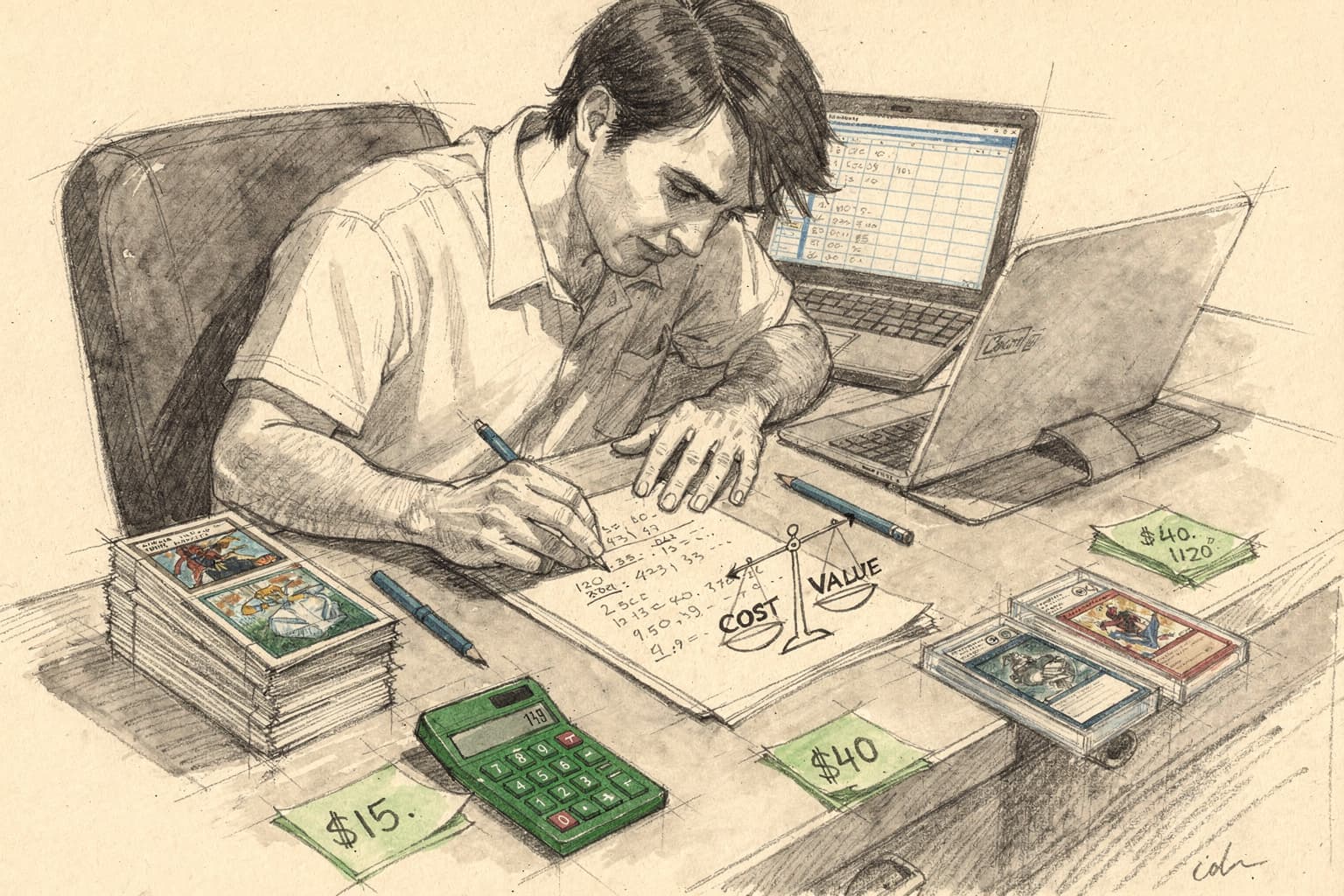
Grading a card costs money, takes time, and introduces uncertainty. A lot of collectors submit cards expecting to win and end up net negative. Here's how to actually calculate whether grading makes sense, and how to avoid the mistakes that burn most people.
The Basic Grading Math
The case for grading is simple: if a card is worth more graded than it costs to grade it, you should grade it. The case against is also simple: if grading costs more than the premium you get, you're losing money.
In practice it's messier because:
- You don't know what grade you'll get before you submit
- The graded premium varies significantly by grade tier (PSA 9 vs. PSA 10 is often a 3x–10x difference)
- Grading company tier pricing changes and has gotten more expensive
- Turnaround times affect your cost of capital
The right framework accounts for all four.
Grade Probability, The Part Most People Skip
The most common grading mistake is submitting without a realistic estimate of what grade you'll receive.
If a card has a realistic shot at PSA 10 and the PSA 10 comps justify the submission cost by a wide margin, it's a strong play. If your card has a corner ding but you're hoping for a 9, you're likely to get an 8, and an 8 might not justify the grading cost at all.
Before you submit, you need to estimate your realistic grade distribution:
- What's the probability of a 10?
- What's the probability of a 9?
- What's the probability of an 8 or lower?
Multiply each probability by the value at that grade, subtract grading costs from the weighted average, and compare to the raw card price. That's your expected value.
A simplified example:
For this hypothetical example, a raw card sells for $50 and the grading fee is $25. These are illustrative inputs, not a current PSA service quote. You estimate:
- 30% chance of PSA 10 → sells for $200
- 50% chance of PSA 9 → sells for $90
- 20% chance of PSA 8 or lower → sells for $60
Expected graded value: (0.30 × $200) + (0.50 × $90) + (0.20 × $60) = $60 + $45 + $12 = $117
Minus $25 grading cost = $92 net expected value
vs. $50 raw. That's a $42 expected gain, a good play.
Now change the numbers: raw card $50, PSA submission $25, but only a 10% chance of PSA 10 and a 60% chance of a 9:
- Expected graded value: (0.10 × $200) + (0.60 × $90) + (0.30 × $60) = $20 + $54 + $18 = $92
- Minus $25 = $67 net expected value
Still a gain, but now only $17, and that's before time cost and liquidity risk.
The Grade Ladder in Practice
What most collectors don't realize is that grading ROI varies dramatically by player, set, and era. Some cards are "grade sensitive", the PSA 10 commands a massive premium over a 9, making grade probability the entire bet. Others are "grade insensitive", a 9 and a 10 are close in value, so the math needs a different input.
Grade-sensitive cards: Modern rookies of top players where the PSA 10 population is low and demand is high. The 9-to-10 premium can be 5x–15x. You either win big or break even.
Grade-insensitive cards: Vintage cards, high-pop modern sets, or players without a strong following. The premium is modest, so you need high grade probability just to break even on costs.
This is why the grade ladder, knowing the value at every grade tier for your specific card, matters more than a simple "what's it worth graded" lookup.
What Slabfy's Grade Ladder Shows
When you pull a grade ladder analysis in Slabfy, you're seeing:
- Market value at Raw, PSA 7, PSA 8, PSA 9, PSA 10 (live comps)
- Your net at each tier after PSA's current submission fee
- The break-even grade (the minimum grade that justifies submission)
- The expected profit if you hit each tier
This makes the decision concrete. Instead of "is it worth grading?" you're looking at: "I need at least a PSA 9 to break even, and I think this card has a 70% chance of getting there, do I take that bet?"
Common Grading Mistakes
Grading because you feel the card is undervalued raw. If the market is right and the card is correctly priced at $40 raw, grading it doesn't unlock hidden value, it just adds cost and uncertainty.
Submitting cards with obvious flaws at premium tiers. A PSA 8 or 9 often doesn't justify a $75 or $100 submission fee. Match your tier to your grade expectation.
Ignoring turnaround time. A 6-month turnaround on a player during their hot season might mean you're getting your card back when the market has cooled. The cost of capital matters.
Not factoring in return shipping, insurance, and your time. Grading ROI calculations often forget these. Add $5–$15 per submission for full-cost accounting.
Submitting pre-rips (sealed packs) speculatively. Unless you have specific intel or an extremely favorable expected value calculation, sealed rips are generally poor grading plays.
When Grading Almost Always Makes Sense
-
Clean modern rookies of elite players with low PSA 10 population. The upside is real and the math often works even at conservative grade estimates.
-
Error cards in gem condition. Error cards are collectible artifacts, a graded example commands a premium that often massively justifies submission.
-
High-end vintage you're planning to hold or sell long-term. Authentication, protection, and liquidity all improve significantly.
-
Cards you're actively trying to sell. A PSA grade removes buyer uncertainty and typically increases sell-through rate and final price.
The Bottom Line
Grading is a business decision, not a hobby instinct. The dealers who profit from grading consistently are the ones who run the math before they submit, not after they see the result.
The grade ladder exists to make that math fast and accurate. Know your break-even grade, estimate your grade probability honestly, and let the numbers tell you whether it's a good bet.
Try the free grading calculator with your own costs and grade estimates. Explore Slabfy's Flip Finder and grade ladder, or review current plans for app access.