How to Spot a Fake PSA, BGS & SGC Slab: A Buyer's Checklist
Counterfeit graded slabs are better than ever in 2026, and a cert-number lookup alone no longer protects you. Here is the full authentication checklist before you buy a graded card.
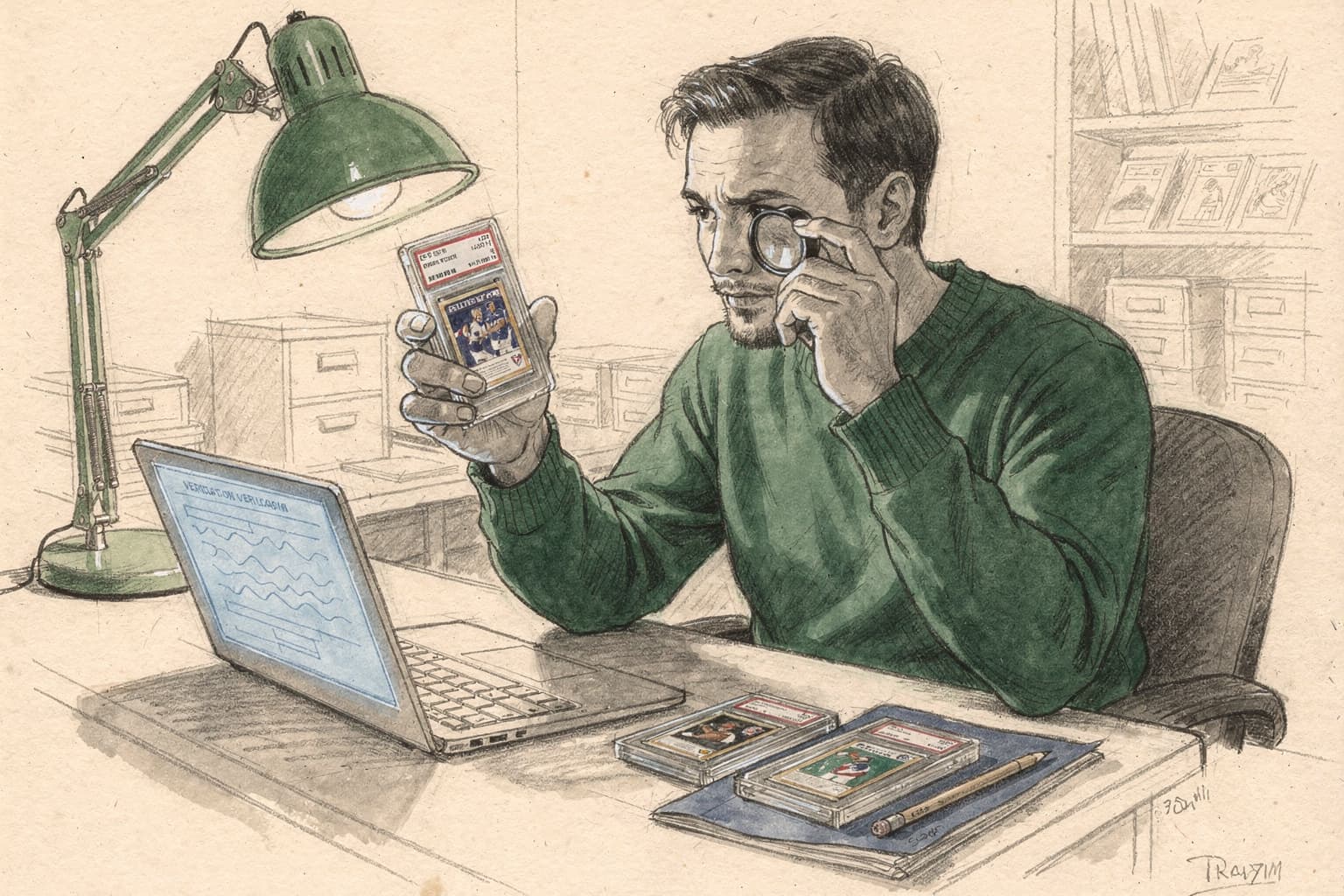
Counterfeit graded slabs used to be a vintage-card problem, something that happened to other people, on high-dollar cards, in shady corners of the hobby. In 2026 it is everyone's problem. The fakes have gotten good. Really good. They replicate holograms, they copy sonic seams, and the most sophisticated ones reuse legitimate cert numbers pulled from real cards, so the one check most buyers rely on, typing the cert into the grader's website, comes back clean.
If you buy graded cards on eBay, at shows, or through social media, you need a verification routine. Not paranoia, a routine. This guide is that routine: what to check, in what order, and what the current generation of fakes is specifically designed to beat.
Why Fakes Got Dangerous
For years, the advice was simple: "just check the cert number." A counterfeiter could fake a slab but couldn't fake the entry in PSA's or Beckett's database, so a cert lookup that matched the card in your hand was considered proof.
That era is over. The current wave of counterfeits does two things differently:
They clone real cert numbers. A scammer takes a legitimate cert number from a genuinely graded card, often lifted from a completed eBay listing's photos, and prints a fake label using that exact number, on a fake card of the same player and set. The lookup matches. The photos in the database might even roughly match. The buyer feels safe and pays.
They replicate the physical security features. Older fakes looked obviously wrong, fuzzy printing, the wrong shade of blue, a flat hologram. Newer ones get the embossing, the color-shift hologram, and the seam quality close enough that a quick glance doesn't catch them.
The takeaway: no single check is enough anymore. Authentication in 2026 is a stack of checks, and a real slab passes all of them while a fake fails at least one.
Step 1: Verify the Cert, But Verify It Properly
Still start with the cert lookup. It is necessary, just not sufficient.
Go to the grader's official site and enter the cert number. Then do the part most people skip: compare the card in your hand (or in the listing photos) to the card shown in the database entry. The grader stores images of the exact card they graded. If the database shows a card with different centering, a different print mark, a scratch in a different spot, or a different scan of the autograph, you are looking at a card wearing someone else's cert number.
Also be suspicious if the lookup result feels "off": a cert that belongs to a different player or set, a grading date that does not match the slab generation, or a population that does not line up. When the number and the card do not tell the same story, walk away.
Step 2: The Physical Slab Checks
If you have the card in hand, or clear, in-person-style video, work through the physical tells.
The hologram. Genuine PSA holograms shift color as you tilt them (a green-to-pink-to-gold range) and the detail stays crisp. Fakes are often static, the wrong color temperature, or slightly blurry under magnification. A hologram that does not move is the single most common giveaway.
The embossing. Real slabs have a crisp, cleanly embossed logo you can feel with a fingernail. Counterfeit embossing tends to be shallow, mushy, or printed flat to fake the look of depth.
The sonic seam. Genuine slabs are sealed with an even, factory-consistent ultrasonic weld around the entire perimeter. Fakes are frequently glued or sealed unevenly, look for gaps, ripples, adhesive residue, or a seam that varies in width as it travels around the case. A slab that looks like it has been opened and re-sealed almost always has.
The label. Check font weight, kerning, and alignment against a slab you know is genuine. Real labels print sharp; fakes often have slightly soft text or color that is a shade off. Some collectors also use a UV light, genuine labels carry hidden security printing that glows under UV, and many fakes do not reproduce it.
The case itself. Weight, thickness, and clarity should match other slabs of the same generation. A case that feels light, flimsy, or noticeably cloudy is a flag.
Step 3: BGS and SGC Have Their Own Tells
Almost every authentication guide online is PSA-only. If you collect across graders, you need the others too.
BGS/Beckett. Look at the subgrade boxes and the inner-sleeve presentation, Beckett's inner well and label printing are hard to replicate cleanly. The case is a multi-piece design; fakes often get the assembly slightly wrong. Verify on Beckett's site, and check that the subgrades shown there match the label.
SGC. The tuxedo-style black border and the slab's distinctive build are the things to scrutinize. Check the foil, the label inset, and the seam, and confirm the cert on SGC's lookup. SGC's rising popularity means it is now worth faking, do not assume "nobody counterfeits SGC."
Whichever grader, the principle is identical: compare against a slab you know is real, and verify the number against the official database with images.
If you are still deciding which grader to trust for your own submissions, our PSA vs BGS vs SGC comparison breaks down the differences.
Step 4: Read the Listing Like an Investigator
Most fakes are caught before money changes hands, in the listing itself.
- Price below market. If a card is priced meaningfully under recent sold comps, that is not a deal, it is a warning. Counterfeiters price to move fast.
- Stock photos or borrowed images. A real seller of a real slab can photograph the actual card. Demand photos of the exact item, including the back and the cert.
- No in-hand video. For anything above pocket change, ask for a short video of the seller holding and tilting the slab. A hologram on video is far harder to fake than a still image. A seller who refuses is telling you something.
- New or low-feedback accounts moving high-value graded cards.
- Pressure to move off-platform. "Pay me on Venmo and I'll knock off 15%" removes every protection you have. Never do it.
Step 5: Sanity-Check the Value Before You Pay
Authentication and pricing are two halves of the same decision. A slab that is real but overpriced still loses you money, and a price that is suspiciously low is itself an authenticity flag.
Before you buy, pull recent sold comps so you know the genuine market value of that card in that grade. The Price Check feature gives you live comps in seconds, so you can answer both questions at once: is this priced like a real card, and is it priced like a good buy. If the asking price does not fit the comp range in either direction, slow down. Our guide on what your sports card is worth walks through reading comps properly.
If You Already Bought a Fake
It happens, even to careful buyers. Move fast.
- Buying on eBay or with PayPal: open an "item not as described" case immediately. Document everything, the listing, the photos, the cert mismatch, the physical tells. Platform buyer protection is generally strong when you can show a counterfeit.
- Report the cert to the grader. If a cloned cert number is circulating, the grader wants to know, and your report helps the next buyer.
- Do not resell it. Knowingly passing a counterfeit on is fraud. Pursue your refund; do not make someone else the victim.
- Paid by irreversible method (cash, Venmo, Zelle, crypto)? Recovery is much harder, which is exactly why you never pay that way for a graded card from someone you do not know.
The 60-Second Pre-Purchase Checklist
Before money moves, every one of these should be a yes:
- Cert number verified on the official site, and the database images match the actual card.
- Hologram shifts color and is sharp under magnification.
- Embossing is crisp; sonic seam is even all the way around.
- Label font, alignment, and color match a known-genuine slab.
- Listing shows real photos of the actual card, front and back, plus an in-hand video for anything of value.
- Asking price sits inside the recent sold-comp range, not suspiciously below it.
- Payment is going through a method with buyer protection.
Any "no," and you either get answers or you walk. There is always another card.
The Bottom Line
The fakes are better than they have ever been, and they are specifically engineered to beat the lazy version of authentication. The cert lookup alone will not save you. What saves you is a routine: verify the number and the images, run the physical checks, read the listing critically, and confirm the price against real comps before you commit.
It takes about a minute once it is a habit. That minute is the cheapest insurance in the hobby.
Verify the slab is real, then confirm the price is right—Slabfy gives you live comps in seconds. Monthly Collector and Collector Plus include a 14-day free trial.