Consignment
Sports Card Consignment Management Software
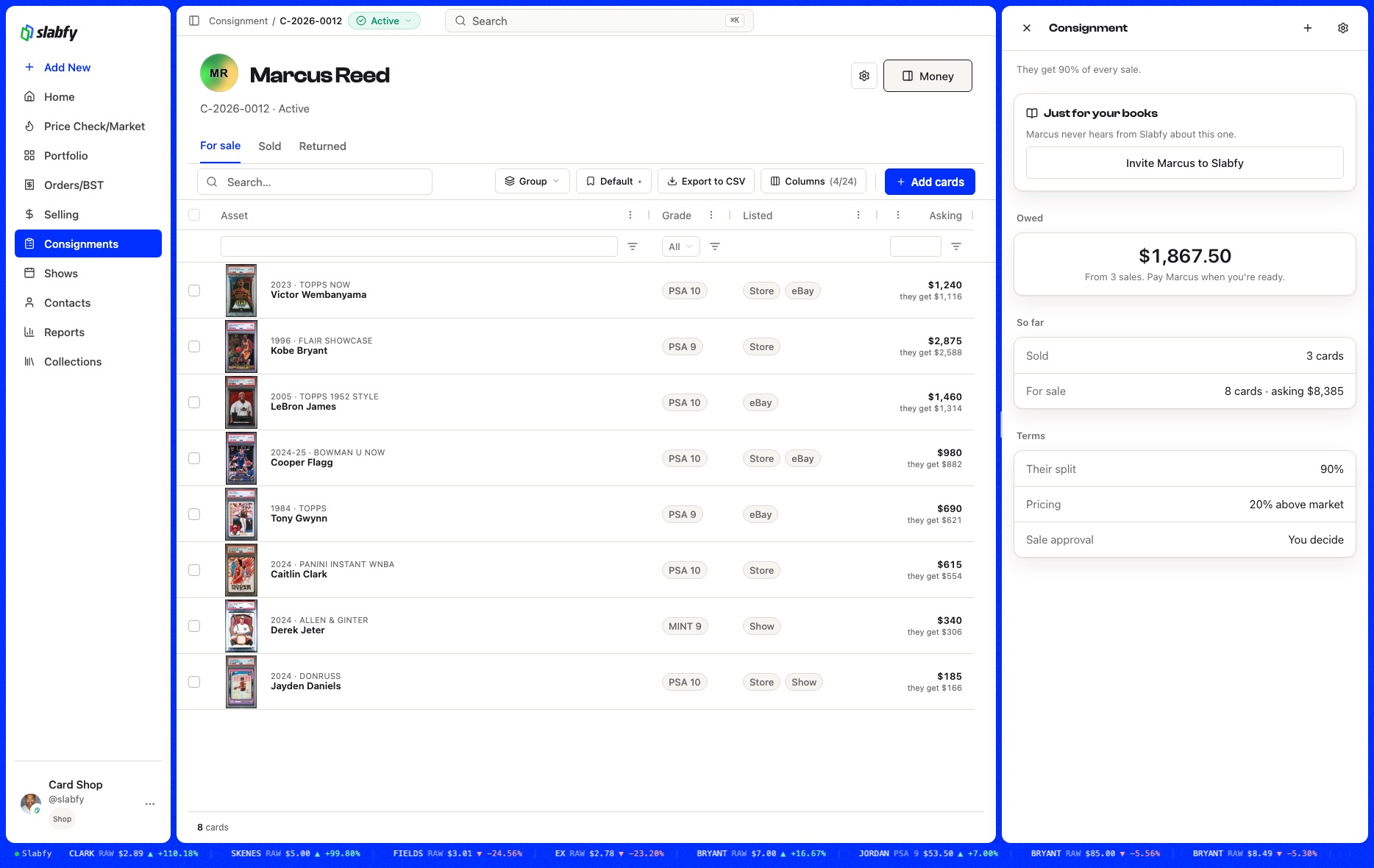
Track which cards belong to which consignor, record when they sell, and Slabfy calculates what's owed — automatically. Market-mode pricing, per-consignor dashboards, and full history of every transaction.
How sports card consignment works
In a consignment arrangement, you keep ownership of your cards the whole time — the dealer or shop sells them on your behalf and takes a commission when they sell. The process is consistent across the hobby: cards are logged and photographed at intake, priced against recent sold comps, listed on eBay or a storefront, and once they sell, paid out — almost always monthly. Sales in one month typically pay out in the first week of the next, with a report of what sold and for how much.
That model works fine on a handful of cards and a spreadsheet. It starts to break the moment you are running consignments for more than a few people at once.
What is a fair consignment commission split?
Most consignment fees are tiered — higher-value cards carry a lower rate. Local shops and mid-tier services commonly charge around 15%, dropping toward 10% on cards above $1,000. Large auction houses often charge the seller nothing and add a buyer's premium of roughly 20% instead, while marketplace consignment programs use a sliding scale of about 7-16% depending on value.
The hobby broadly accepts 10-20%, with 15% the unspoken standard for a local shop. Where consignors cry foul: splits above 30%, marketplace fees stacked on top of the commission without warning, and per-card listing or photo fees that quietly erase the return on lower-value cards. Whatever the rate, the rule is the same — put the split, the fees, and who covers eBay and shipping costs in writing before a single card is listed.
Why dealers outgrow the spreadsheet
Most dealers start consignments with a spreadsheet, a few text threads, and memory. It holds together for three consignors. At thirty, it falls apart. Cards get mixed up between owners. Payouts run late because the monthly reconciliation is done by hand. A consignor asks what sold, and the honest answer is "let me check and get back to you." Every one of those is a trust problem — and consignment is a trust business.
The root issue is that consigned cards are shadow inventory: you are holding them, but you do not own them, and most tools only understand "owned" or "not owned." Tracking whose card is whose, at scale, with the split math attached, is exactly the job a spreadsheet was never built for.
How Slabfy handles consignments
- • Assign cards to consignors when adding to inventory
- • Market-mode pricing: auto-price at X% above market with configurable rounding
- • Automatic payout calculation based on commission split
- • Per-consignor dashboard — cards in, cards sold, balance owed
- • Full history of every consignment transaction
- • Seamless integration with Card Show POS and eBay
Built for how dealers actually work
Whether you have 3 consignors or 30, Slabfy keeps everything organized. Sell a consigned card at a card show and the payout updates instantly. List it on eBay and the consignment status follows. No double-entry, no reconciliation headaches.
Frequently asked questions
Do I still own my cards while they're consigned?
Yes. In a consignment arrangement, the consignor keeps ownership of every card until it sells. The dealer or shop is selling on your behalf and takes a commission — they are not buying the cards from you.
What is a typical consignment commission split?
Most consignment fees are tiered, with higher-value cards charged a lower rate. Local shops and mid-tier services commonly charge around 15%, dropping toward 10% on cards above $1,000. Large auction houses often charge the seller nothing and add a buyer's premium of around 20% instead.
Who pays the eBay and shipping fees on a consigned card?
It depends on the agreement. Auction-house models usually build marketplace fees into their commission, while shop arrangements vary — so confirm in writing who covers eBay's fees before any card is listed. Buyers typically pay shipping.
When do consignors get paid?
Almost all consignment services pay out monthly. Cards that sell in one month are typically paid in the first week of the following month, along with a report of what sold and for how much.
What happens to cards that don't sell?
That depends on the agreement, which is exactly why it should be in writing. A fair arrangement returns unsold cards or relists them. Be cautious of terms — common in low-end auction services — that transfer ownership of unsold or no-bid cards to the dealer.
How does Slabfy track consignments?
Assign each card to its consignor when it enters inventory. Slabfy records the sale, calculates the payout automatically from your commission split, and gives every consignor a dashboard showing cards in, cards sold, and the balance owed.