Should I Grade My Card? How to Know If Grading Is Worth It
The definitive guide to deciding whether grading your sports card is worth the cost. Real math, real examples, and a free grade ladder that does the calculation for you.
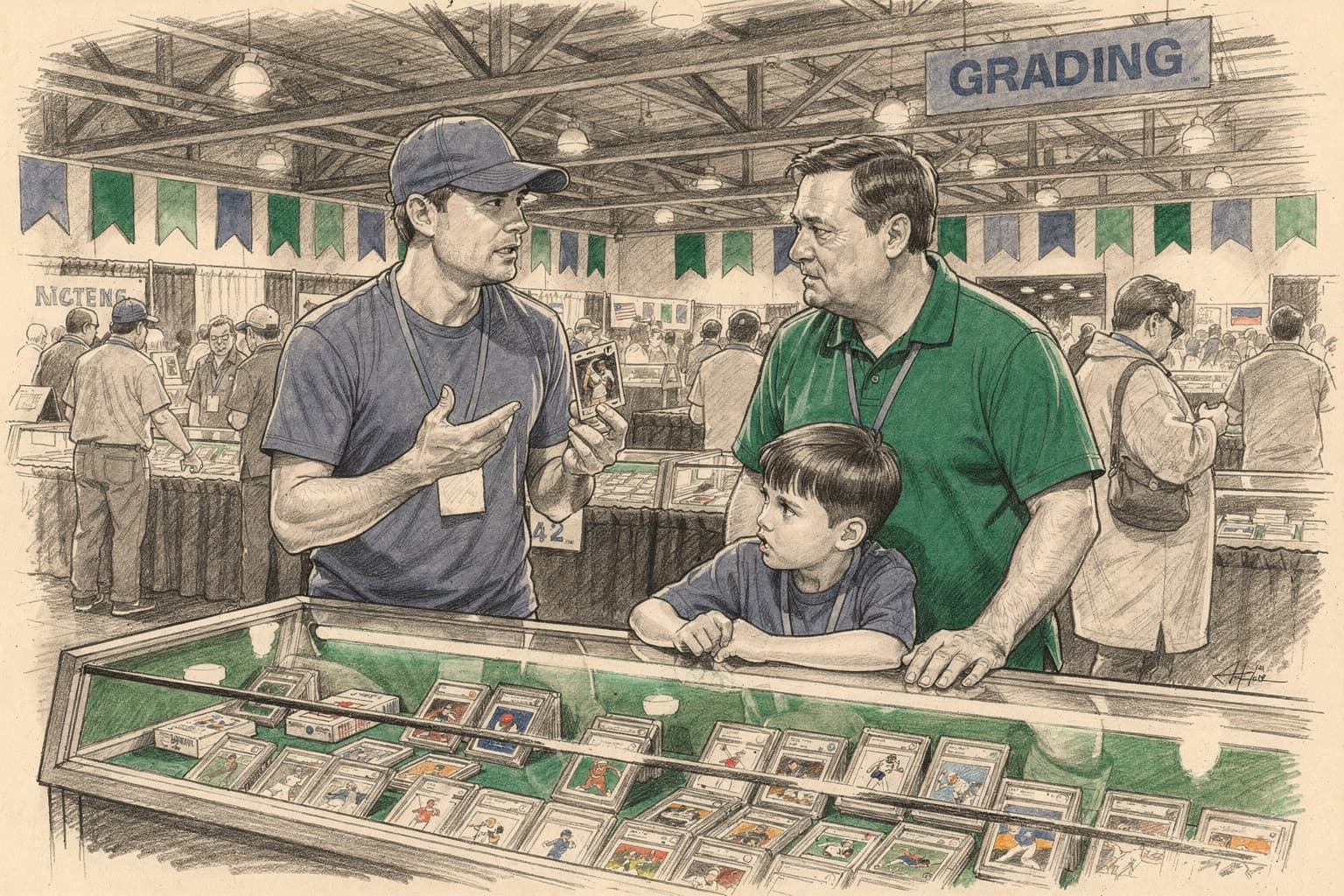
"Should I grade my card?" is the single most-asked question in the sports card hobby. It comes up in every Facebook group, every Discord server, every card show conversation. And almost everyone answers it the same way: they guess.
They eyeball the card, check one or two eBay listings, and go with their gut. Some get lucky. Many don't. The result is a garage full of PSA 8s that cost more to grade than they're worth on the secondary market.
Here's the thing, this isn't a question you need to guess at. It's a math problem. The inputs are knowable. The formula is simple. And once you see it, you'll never submit a card blindly again.
The Simple Math Behind Every Grading Decision
Grade your card if the expected value at grade minus grading cost minus raw value equals a positive number, if the result is negative, grading loses money.
The entire grading decision comes down to one formula:
Expected value at grade - grading cost - current raw value = profit (or loss)
That's it. If the number is positive, grading makes sense. If it's negative, you're burning money. If it's close to zero, you're taking on risk and time cost for essentially nothing.
The problem isn't that the formula is complicated. The problem is that the data you need to plug in is scattered across five different sources. You need raw card comps from eBay. You need graded comps at each grade tier. You need current PSA, BGS, or SGC pricing. You need to estimate your grade probability. And you need to factor in shipping and insurance.
Most people don't do this work. They look at one PSA 10 comp, assume they'll get a 10, and submit. That's not a strategy, it's a lottery ticket.
Let's break down each variable so you can actually run the numbers.
What Grading Actually Costs in 2026
All-in grading cost is roughly $30 per card at the cheapest tier when you factor in the per-card fee plus round-trip shipping and insurance.
Grading prices have changed significantly over the past few years. PSA raised prices again in September 2025, and the other companies have adjusted accordingly. Here's where things stand heading into 2026.
PSA (Professional Sports Authenticator):
- Economy: $25/card, turnaround 90-150 business days
- Regular: $50/card, turnaround 30-60 business days
- Express: $100/card, turnaround 10-15 business days
- Super Express: $150/card, turnaround 5 business days
- Walk-through and higher tiers go up from there for high-value cards
BGS (Beckett Grading Services):
- Standard: $25/card, turnaround 60-120 business days
- Priority: $50/card, turnaround 15-30 business days
- Premium and higher tiers scale up with faster turnaround
SGC (Sportscard Guaranty Company):
- Economy: $20/card, turnaround 45-75 business days
- Standard: $30/card, turnaround 20-30 business days
- Higher tiers available for faster service
On top of the per-card fee, you're paying shipping both ways plus insurance on the return. For a small submission of 1-5 cards, figure $10-$15 each way. That adds roughly $4-$8 per card to your total cost depending on submission size.
Always verify current pricing directly with each grading company before submitting, these numbers shift regularly.
The takeaway: even at the cheapest tier, you're looking at roughly $30 all-in per card when you factor in shipping. That number matters a lot when you're doing the math on whether grading is profitable.
When Grading IS Worth It
Grading is worth it when the PSA 10 value is at least 3x the raw price plus grading cost, and the card has realistic odds of earning that top grade.
Let's run three real-world scenarios so you can see how the math works in practice.
Example 1: The Clear Winner
You have a 2024 Bowman Chrome 1st Jayden Wetteman that looks mint. Here are the numbers:
- Raw card sells for: $8
- PSA 10 sells for: $80
- Grading cost (Economy + shipping share): $30
- You estimate an 80% chance of a PSA 10 and 20% chance of a PSA 9
Expected graded value: (0.80 x $80) + (0.20 x $20) = $64 + $4 = $68
Profit: $68 - $30 cost - $8 raw value = $30 net gain
That's a 280% ROI on your grading investment. This is a clear grade-it situation. The PSA 10 premium is 10x the raw value, and your expected grade is strong. Submit this card.
Example 2: The Marginal Call
You have a modern base rookie that's in good shape:
- Raw card sells for: $15
- PSA 10 sells for: $45
- PSA 9 sells for: $22
- Grading cost: $30
- You estimate 60% chance of a 10, 40% chance of a 9
Expected graded value: (0.60 x $45) + (0.40 x $22) = $27 + $8.80 = $35.80
Profit: $35.80 - $30 cost - $15 raw value = -$9.20 loss
Wait, that's actually a loss when you account for the full picture. Even though the PSA 10 price looks appealing at 3x raw, the realistic grade probability and total grading cost make this a losing proposition. Most people would have submitted this card and lost money.
Example 3: The Money Pit
You have a mid-tier vintage card in decent condition:
- Raw card sells for: $50
- PSA 10 sells for: $65 (yes, some cards have a tiny graded premium)
- Grading cost (Regular tier for higher value): $55
Profit: $65 - $55 - $50 = -$40 loss
This is a disaster. The graded premium doesn't even cover the grading cost, let alone make back what the raw card is already worth. Don't grade this card.
When Grading Is NOT Worth It
Do not grade cards under $15 raw value, vintage cards with visible flaws, high-population modern cards, or cards from players with declining markets.
After running thousands of these calculations, clear patterns emerge. Here are the situations where grading almost never makes financial sense.
Cards with a raw value under $15. At $30 all-in grading cost, you need the graded version to sell for at least $45 just to break even, and that's assuming you get the top grade. For most cards in this range, the PSA 10 doesn't command a 3x+ premium. The math rarely works.
Vintage cards with visible condition issues. If your 1975 Topps has a soft corner or surface wear, you're probably looking at a PSA 6 or 7. For most vintage base cards, a PSA 6 doesn't sell for meaningfully more than raw. You're paying $30+ to put a number on a card that the market already prices accurately.
High-population modern cards. When a card has a PSA 10 population of 50,000 or more, the premium for a graded copy shrinks because supply is enormous. The 2018 Prizm Luka Doncic base has over 30,000 PSA 10s. That kind of supply compresses the premium and makes grading less attractive for future submissions.
Cards from a player with a declining market. If a player's comps have been trending down for six months, grading adds time, 60 to 150 days at economy tiers. By the time you get the card back, the market may have dropped further. You're locking up capital in a depreciating asset and paying for the privilege.
Cards you plan to keep in your personal collection. If you're never selling, the financial math is irrelevant. Grade for the display value and protection if you want, but don't pretend it's an investment decision.
The Crack-and-Resubmit Play
Cracking a lower-graded slab and resubmitting to PSA only makes sense when the PSA 10 premium significantly exceeds the cost of paying grading fees twice.
There's a second version of the grading question that experienced collectors wrestle with: "Should I crack this slab and resubmit?"
This comes up when you have a PSA 8 or BGS 8.5 and the PSA 10 premium is massive. The idea is to crack the case, resubmit to PSA, and hope the card comes back at a 9 or 10.
The math here follows the same formula, but the inputs change:
- Your "raw value" is now the current slabbed value (what the PSA 8 sells for)
- Your grading cost is the same
- Your expected grade distribution needs to account for the fact that the card already received a lower grade from a professional grader
This is where people get into trouble. A card that got a PSA 8 the first time has a reason it got an 8. Maybe the centering is off. Maybe there's a surface issue you can't see without magnification. Resubmitting doesn't change the card, you're betting that a different grader on a different day will be more generous.
When it makes sense: The PSA 10 sells for $500 and your PSA 8 sells for $80. Even if you only have a 20% chance of jumping to a 10, the expected value is significant. A BGS 8.5 being cracked and sent to PSA can sometimes upgrade because the grading scales don't perfectly overlap.
When it doesn't: The grade premium between your current slab and the next tier up is modest. If your PSA 8 is worth $40 and a PSA 9 is worth $55, you're risking a $40 card and paying $30 to grade for a chance at $15 upside. And there's real downside, the card could come back as a PSA 7 on resubmission.
The crack-and-resubmit play is a calculated gamble. Run the expected value calculation before you crack anything.
PSA vs BGS vs SGC, Which Company Should You Use?
PSA commands the highest resale premium for modern cards, BGS offers sub-grades and the Black Label tier, and SGC is the budget-friendly choice with faster turnaround.
This decision intersects directly with the "should I grade" question because your choice of grading company affects the resale premium, and therefore the math.
PSA commands the highest premium for most modern cards. When buyers search eBay for graded cards, they search "PSA 10." The demand pool is the largest, which means higher sale prices and faster sales. For most modern cards you plan to sell, PSA is the default choice despite the higher cost.
BGS occupies a unique position because of its sub-grade system. A BGS 9.5 with strong sub-grades is functionally equivalent to a PSA 10 in card quality, and knowledgeable buyers understand this. For cards where the BGS 9.5 sells near PSA 10 pricing, BGS can be a smart play, especially if grading cost is lower. The BGS Black Label 10 (all four sub-grades at 10) can actually exceed PSA 10 pricing on high-demand cards.
SGC is the value play. Lower cost, faster turnaround, and growing credibility. SGC 10s typically sell for 10-20% less than PSA 10s on modern cards, but the gap has been narrowing. For vintage cards, SGC slabs trade at near-parity with PSA in many cases. If you're grading a vintage card or the grading cost differential changes the math from loss to profit, SGC is worth serious consideration.
The right answer depends on the card, the cost difference, and what you plan to do with it. There's no universal best company, just the one that makes the math work for your specific situation.
The Free Tool That Does This Math For You
Slabfy's Grade Ladder automatically pulls comps at every grade tier for PSA, BGS, and SGC, then calculates profit or loss after grading costs, in seconds.
Everything above is straightforward in theory. In practice, looking up raw comps, checking graded comps at every grade tier, factoring in grading costs, and running the expected value calculation takes 15-20 minutes per card. If you have a stack of 30 cards to evaluate, that's an entire afternoon of eBay research.
That's why Slabfy built the Grade Ladder.
The Grade Ladder runs parallel searches across every grade tier, PSA 7, 8, 9, 10, BGS 9.5, SGC 10, and pulls real comp data for your specific card. It computes the profit or loss after grading costs automatically for each tier and each grading company.
Instead of toggling between eBay tabs, pop report databases, and a spreadsheet, you get one view that shows exactly where the money is (or isn't) across the entire grading spectrum. You can see immediately whether a card is a strong grading candidate, a marginal call, or a money pit.
You don't need to search eBay. You don't need to look up pop reports. You don't need to build a spreadsheet. The Grade Ladder does the work and gives you a clear answer.
Quick Decision Framework
Check four things: is the raw card worth over $15, is the PSA 10 premium over 3x raw, is the pop count under 500, and can you realistically expect a 9 or 10?
If you want a fast mental model before you run the full numbers, here's a decision tree that covers most situations:
Step 1: Is the raw card worth more than $15? If no, the grading cost is likely too high relative to the potential premium. The math rarely works for cards under $15 raw unless the PSA 10 premium is extreme (10x+). Move on.
Step 2: Is the PSA 10 (or BGS 9.5) premium more than 3x the raw price? If yes, this is a strong grading candidate. A 3x+ premium means there's enough upside to absorb grading costs, shipping, and the risk of a lower-than-expected grade.
Step 3: Is the pop count low (under 500 for PSA 10)? If yes, the card is even more attractive for grading. Low population means less supply competing with yours on the market, which supports the premium.
Step 4: Can you realistically expect a 9 or 10? Inspect the card under good lighting with magnification. Check centering. Look at corners and edges. If the card has any visible flaws, your expected grade drops, and so does your expected profit.
Step 5: Still unsure? Run it through the Grade Ladder. It takes 30 seconds and gives you real numbers instead of guesses.
If a card clears all four steps, grade it. If it fails at step 1 or 2, don't. If it's somewhere in between, the Grade Ladder will tell you exactly where you stand.
The Bottom Line
"Should I grade my card" is a math question, not a gut feeling, run the expected value calculation before every submission and only grade when the numbers are clearly positive.
"Should I grade my card?" isn't a vibes question. It's a math question. And the math is not hard, it just requires data that most people don't bother to gather.
The collectors who consistently make money grading cards aren't luckier than everyone else. They run the numbers before they submit. They know their expected grade. They know the graded premium at each tier. They know their break-even point. And they only submit when the expected value is clearly positive.
The collectors who lose money grading submit everything that looks clean, hope for a 10, and don't think about the math until the card comes back as a 9 and they realize they lost money.
Don't be the second type. Run the numbers. Use the tools that exist to make this faster. And only grade when the math says yes.
Try the Grade Ladder with a 14-day free trial on monthly Collector or Collector Plus. Start here.