Sports Card Storage Guide: How to Protect and Preserve Your Collection
The complete guide to sports card storage and protection. Penny sleeves, top loaders, mag cases, graded slab storage, climate control, and insurance for collectors and dealers.
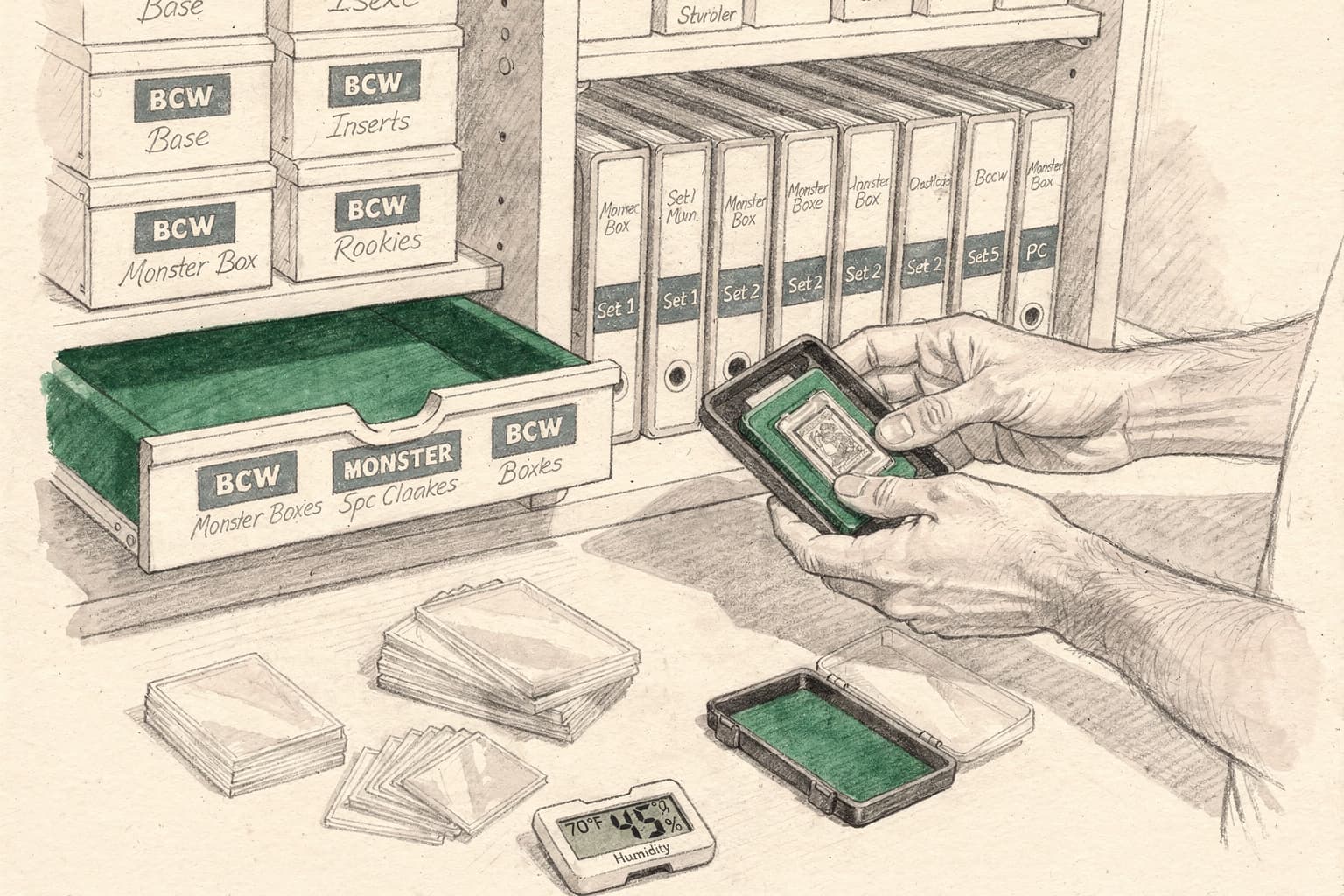
You can spend hours hunting for the right card at the right price, but if you store it wrong, none of that matters. Bad storage is the silent killer of card value. Heat, humidity, UV light, and plain old carelessness have destroyed more collections than any market crash ever will.
This guide covers everything from protecting a single raw card to storing thousands of graded slabs -- plus the climate control and insurance steps most collectors skip until it's too late.
Why Proper Storage Matters More Than You Think
Cards lose value the moment they're damaged, and most damage happens at home, not in transit. A corner ding from a loose stack, a surface warp from humidity, or sun bleaching from a shelf near a window -- these are permanent and they tank resale prices.
A PSA 9 and a PSA 7 of the same card can have a significant price gap -- often 50% or more, and sometimes 10x on high-demand cards. That gap often comes down to how the card was stored before it was graded. Even if you never plan to grade, buyers can spot storage damage instantly. Cards that look "off" sit in your inventory forever.
The cost of proper storage supplies is trivial compared to what you stand to lose. A penny sleeve costs a few cents. A top loader runs about 15-25 cents. Protecting a $200 card with less than 30 cents of supplies is the best return on investment in the hobby.
Raw Card Protection: Penny Sleeves, Top Loaders, and Beyond
Every raw card worth more than a few dollars should be in a penny sleeve inside a top loader at minimum. This is the baseline. If you're not doing this, start today.
Here's the hierarchy of raw card protection, from basic to premium:
Penny Sleeves
The foundation of card protection. These soft, clear plastic sleeves prevent surface scratches and keep dust off the card face. Ultra Pro penny sleeves are the industry standard -- they fit standard-size cards perfectly and come in packs of 100 for about $2-4.
Always sleeve a card before putting it in a top loader. Never put a raw card directly into a rigid holder -- the card will slide around and the edges will get chewed up.
Top Loaders
Rigid plastic holders that protect against bending and corner damage. Ultra Pro 35-point top loaders are the standard for most base cards. If you're storing thicker cards (jersey patches, relics), step up to 55pt, 75pt, or 130pt top loaders to avoid warping.
Pro tip: after inserting the sleeved card, fold a small piece of painter's tape over the opening to keep the card from sliding out. Some collectors use "team bags" over the top loader instead, which also works and avoids adhesive near the card.
Semi-Rigid Holders (Card Savers)
Card Saver I and Card Saver II holders are the preferred submission holders for PSA, BGS, and SGC. They're semi-flexible, which makes them easier to ship and less likely to cause damage during transit than top loaders. If you're planning to submit cards for grading, keep a stack of Card Saver I holders on hand.
Magnetic Cases (One-Touch)
Ultra Pro One-Touch magnetic cases are the premium option for raw cards. They snap shut with embedded magnets -- no screws, no sliding. They look great for display and offer the best protection short of getting the card graded.
Use the right thickness: 35pt for standard cards, 55pt for slightly thicker, and so on up to 360pt for massive relic cards. A card rattling around in an oversized One-Touch is worse than a properly fitted top loader.
One-Touches run about $3-5 each, so they're not practical for every card. Reserve them for your higher-value raw cards -- anything you'd be upset about damaging.
Graded Slab Storage: Protecting Your Graded Cards
Graded slabs need protection too -- the cases scratch easily and cracked slabs kill resale value. Don't assume the grading company's holder is all the protection you need.
Slab Sleeves
Resealable plastic sleeves sized for graded card slabs. They prevent surface scratches on the case itself and keep dust from settling in the label area. Basically penny sleeves for your slabs. Companies like BCW, Ultra Pro, and Cardboard Gold all make them. Budget about $5-8 per 100.
Slab Cases and Slab Boxes
For serious collections, dedicated slab storage boxes are worth the investment. BCW makes graded card storage boxes that hold 25-50 slabs standing upright with dividers. The cards stay snug and organized instead of stacked on top of each other (stacking puts pressure on the bottom slabs and increases the risk of case cracks).
Display Solutions
If you want to show off your best slabs, use proper card stands or wall-mounted display cases with UV-filtering glass. Avoid placing displayed cards in direct sunlight or under halogen lights. LED lighting is the safest option for display setups.
Detolf display cabinets from IKEA are popular in the hobby -- affordable, glass-enclosed, and they keep dust out while letting you see your cards. Just keep them away from windows.
Bulk Storage for Dealers and Large Collections
Monster boxes and BCW storage boxes are the workhorses of bulk card storage -- cheap, stackable, and they last. If you're moving volume at card shows or managing dealer inventory, you need a system.
Monster Boxes
BCW Monster Boxes hold roughly 3,200 standard cards (sleeved and in top loaders, the count drops significantly). They're sturdy corrugated cardboard with a lid, and they stack well. For raw cards in penny sleeves only, you can fit thousands per box.
BCW Row Boxes
Available in sizes from 100-count to 5,000-count. The 800-count and 3,200-count boxes are the most popular for dealers. Label the outside of each box with the sport, year range, and any other sorting criteria you use.
Organization Systems
This is where most collectors fail. Buying boxes is easy; actually organizing the contents is the hard part. Pick a system and stick with it:
- By sport, then year, then set -- the most common approach for large collections
- By player -- works well if you're a player collector or dealer who sells by player
- By value tier -- separate your hits from your commons so your best cards get the best protection
- By sale status -- what's listed, what's sold and needs to ship, what's available
Whatever system you choose, having a digital record of what's in each box saves enormous time. This is where a tool like Slabfy pays for itself -- you can track your full portfolio, know exactly what each card is worth today, and find any card in seconds instead of digging through boxes at a show.
Climate Control: Temperature, Humidity, and UV
Store cards at 65-72 degrees Fahrenheit with 40-50% relative humidity, away from all direct light. This is the single most important long-term storage factor most collectors ignore.
Temperature
Heat warps cards. Attics, garages, and cars are the worst offenders. A car interior can hit 150+ degrees in summer -- never leave cards in your vehicle. Even brief exposure to extreme heat can cause permanent warping, especially for vintage cards and thick relic cards.
Keep your collection in a climate-controlled room. If your only option is a basement, get a dehumidifier (more on that below).
Humidity
This is the big one. High humidity causes cards to warp, encourages mold growth, and can make surfaces tacky. Low humidity can make older cards brittle and prone to cracking.
The sweet spot is 40-50% relative humidity. A basic hygrometer costs about $10 on Amazon and tells you exactly where you stand. If you're above 60%, get a dehumidifier running in your storage area. If you're below 30% (common in winter with forced-air heating), a humidifier helps.
For extra protection in humid environments, toss silica gel packets into your storage boxes. They absorb excess moisture and cost almost nothing.
UV Light
Ultraviolet light fades card surfaces over time. This includes direct sunlight, fluorescent lights, and some LED bulbs. If you display cards, use UV-filtering sleeves or cases, and keep them away from windows.
Cards stored in boxes in a closet don't have UV concerns. Cards on display shelves near windows absolutely do.
Insurance and Documentation
If your collection is worth more than a few thousand dollars, you need insurance and a documented inventory. Homeowner's or renter's insurance typically has low limits for collectibles, and you'll need proof of what you owned if you ever file a claim.
Insurance Options
Standard homeowner's policies often cap collectibles coverage at $1,000-2,500 total. That's probably not enough. You have two main options:
- Scheduled personal property endorsement -- add your collection to your existing homeowner's policy with a specific declared value. Usually requires an appraisal or detailed inventory.
- Standalone collectibles insurance -- companies like Collectibles Insurance Services (CIS) offer policies specifically designed for card collections, with no deductible and coverage for a wide range of loss scenarios.
Either way, you'll need an inventory with current market values. Take photos of your highest-value cards and keep receipts for major purchases.
Documentation
At bare minimum, maintain a spreadsheet or app-based inventory of every card worth over $20-50. Include the card name, year, set, condition or grade, and approximate value. Update values periodically -- the market moves, and your insurance coverage should reflect current prices. Tools that track your collection digitally make this dramatically easier than doing it by hand.
Store your documentation in the cloud (Google Drive, iCloud, Dropbox) so it survives the same disaster that might take out your cards.
Common Storage Mistakes That Destroy Value
Rubber bands, PVC binders, and stacking slabs are the three most common ways collectors unknowingly damage their own cards. Here's what to avoid:
- Rubber bands around cards -- they leave indentations and chemical residue on card surfaces. Never use them. Ever.
- PVC binder pages -- the old-school soft plastic pages contain PVC, which breaks down over time and leaves a greasy film on cards. Use only acid-free, archival-quality pages. If your pages smell like plastic, they're probably PVC.
- Stacking graded slabs flat -- the weight causes stress cracks in the cases at the bottom of the stack. Store slabs upright in proper boxes.
- Storing cards in attics or garages -- temperature swings and humidity will destroy even well-protected cards over time.
- Leaving cards in shipping mailers -- bubble mailers and padded envelopes are for transit, not storage. Unpack and properly store cards as soon as they arrive.
- Overstuffing top loaders -- forcing a thick card into a standard 35pt top loader warps both the card and the holder. Match the point thickness to the card.
- Touching card surfaces -- oils from your hands cause surface damage over time. Handle cards by the edges, or better yet, wear clean cotton gloves when handling high-value raw cards.
The Bottom Line
Proper storage isn't glamorous, but it's the difference between a collection that holds its value and one that slowly deteriorates in a closet. The supplies are cheap. The habits are simple. The alternative -- watching your cards lose grade-worthy condition because of preventable damage -- is expensive.
Start with the basics: penny sleeves and top loaders for every card worth protecting. Get a hygrometer for your storage area. Keep your best cards in One-Touch cases or proper slab storage. Document what you own. And if your collection has real value, insure it.
Your cards are only worth what their condition allows. Protect them accordingly.