Sports Card Investing for Beginners: How to Build a Profitable Portfolio
A beginner's guide to sports card investing in 2026. Learn which cards hold value, how to evaluate ROI, avoid common traps, and build a card portfolio that actually makes money.
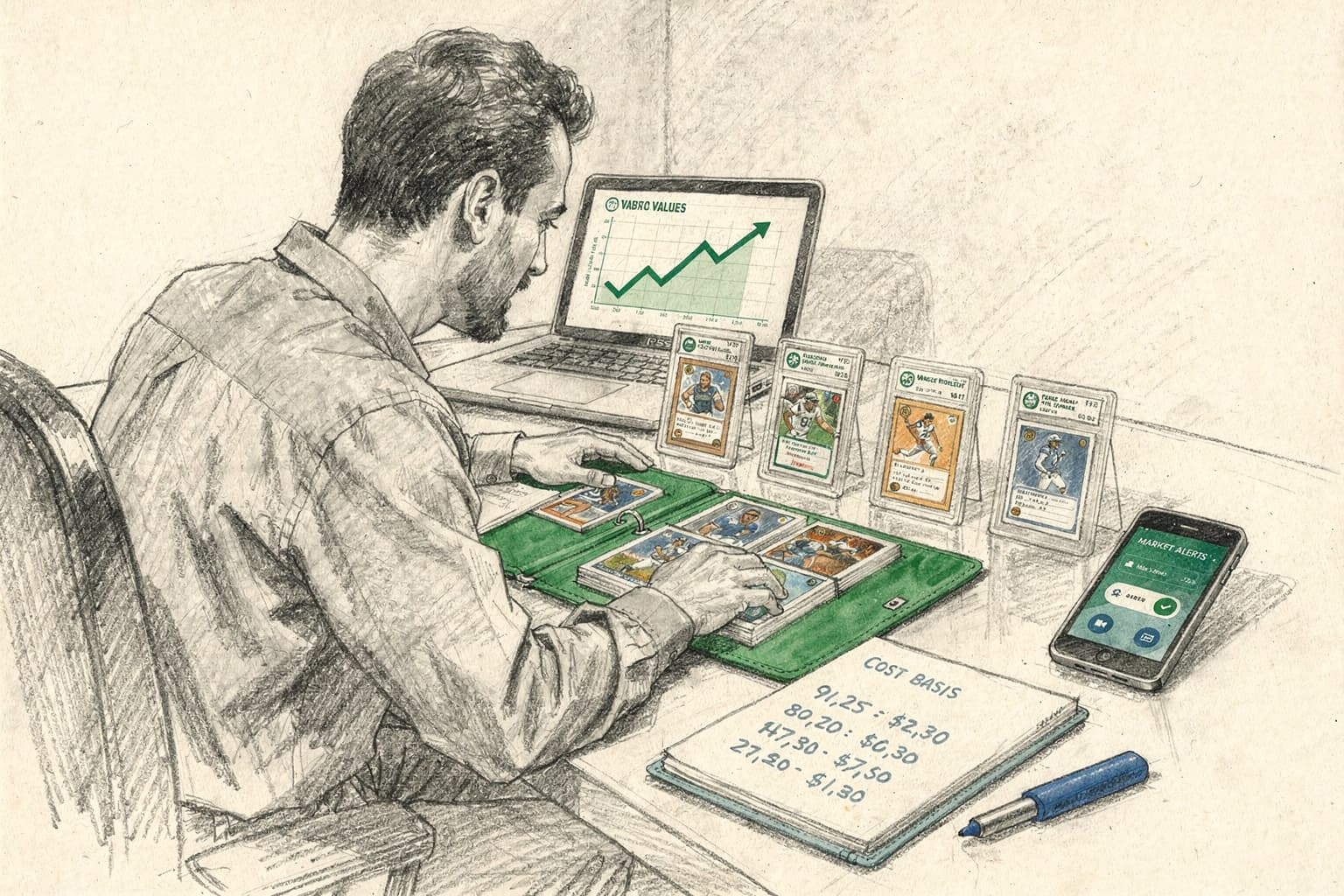
Sports cards aren't just nostalgic shoebox relics anymore. They're a legitimate alternative asset class, with real upside and real risk. This guide covers the fundamentals of sports card investing, from evaluating individual cards to building a diversified portfolio that holds up over time. None of this is financial advice, but it is hard-earned collector wisdom from people who have actually made (and lost) real money doing this.
Are Sports Cards a Good Investment in 2026?
Yes, selectively, cards with strong fundamentals have outperformed many traditional assets, but the average card loses value over time.
The sports card market has matured significantly since the pandemic boom of 2020-2021. That era brought a wave of new money, irrational pricing, and a lot of people buying at the top. Some of those people got burned. But the underlying market is healthier for it.
In 2026, the hobby is more data-driven than ever. Pricing comps are transparent, grading populations are public, and tools exist to calculate actual ROI before you buy. The casual speculation has calmed down, and what's left is a market that rewards research, patience, and discipline, the same things that make any investment strategy work.
The honest answer to "are sports cards a good investment" is: it depends entirely on what you buy, when you buy it, and whether you did the work before spending money. The average card sitting in a box at a card show is not a good investment. A carefully selected, properly graded card of a young player with strong fundamentals? That can absolutely outperform.
How Sports Card Values Work
Card prices are driven by four forces: comparable sales, grade, population scarcity, and market sentiment, ignore any one of them and you'll misprice.
Understanding how card values are determined is the foundation of card investing. There's no central exchange or ticker symbol. Card prices are set by what people actually pay for them in completed transactions.
Comparable sales (comps) are the backbone of card pricing. When someone asks how much is my sports card worth, the answer comes from looking at what identical or near-identical cards have recently sold for on eBay, auction houses, and marketplace platforms. Raw comps and graded comps are two different markets.
Grade is the condition score assigned by a third-party grading company (PSA, BGS, SGC). The difference between grades is not linear, a PSA 10 of a popular rookie card might sell for 5x or 10x what the PSA 9 commands. This is why understanding grading ROI is critical before you submit anything.
Population refers to how many copies of a card exist at a given grade. PSA publishes population reports showing exactly how many of each card they've graded at each level. A card with 50 PSA 10s in existence has a very different value proposition than one with 5,000.
Sentiment is the market's current feeling about a player, set, or category. A player going on a hot streak, getting traded to a contender, or entering a Hall of Fame class can move prices overnight. Sentiment is the most volatile factor, and the one most beginners underestimate.
Types of Card Investments
Rookie cards, vintage, graded modern, sealed wax, and Pokemon each carry different risk profiles, diversifying across categories reduces exposure to any single market swing.
Not all card investments behave the same way. Here are the main categories and what makes each one tick.
Rookie cards are the blue chips of the hobby. A player's first licensed card is the default unit of investment. For modern players, flagship Topps or Panini rookies in high grade are the most liquid. The risk: player performance. If your guy gets hurt or declines, the card follows.
Vintage cards (pre-1980) behave more like fine art. Supply is permanently fixed, condition sensitivity is extreme, and the buyer base skews older and wealthier. Vintage tends to be more stable during downturns but has less explosive upside. Think of it as the bond allocation in your card portfolio.
Graded modern cards are the most actively traded segment. High-grade PSA 10s of current stars and prospects are bought and sold constantly, making them the most liquid card investment. The downside is that modern print runs are enormous, so scarcity has to come from the grade, not the card itself.
Sealed wax (unopened packs and boxes) is a bet on nostalgia and scarcity. Once a product is out of print, sealed boxes only get rarer. Historically, sealed wax of popular sets has appreciated well, but it requires significant capital and patience.
Pokemon and non-sport cards have proven they're not a fad. First-edition Base Set cards have appreciated faster than most sports cards over the past decade. The collector base is global and generational. If you're building a diversified card portfolio, ignoring Pokemon is leaving money on the table.
How to Evaluate a Card Before Buying
Before spending a dollar, check four things: recent comps, the PSA population report, the grading cost breakeven, and whether sentiment is peaking or building.
This is where most beginners go wrong. They buy on impulse, a card looks cool, a player is hot, someone on YouTube said it's a must-buy. That's not investing, that's gambling.
Here's a practical evaluation framework:
Step 1: Pull comps. Look at the last 30-90 days of completed sales for the exact card, year, set, parallel, and grade you're considering. Don't compare a PSA 9 comp to a PSA 10 listing. Don't compare a base card to a numbered parallel. Apples to apples.
Step 2: Check the population. Go to the grading company's population report. How many copies exist at this grade? Is the population growing fast (meaning more supply is coming) or is it stabilized? A card where the PSA 10 population doubled in the last year has a supply problem.
Step 3: Calculate the grading breakeven (if buying raw). Use a grading calculator to figure out whether the raw-to-graded premium justifies the grading cost and risk. If the expected value after grading doesn't significantly exceed what you'd pay for a raw copy, buying pre-graded is the smarter play.
Step 4: Assess sentiment. Is this player in the middle of a hot streak, or is this a quiet accumulation window? Buying during peak hype means paying peak prices. The best card investments are made when nobody is talking about a player, and sold when everyone is.
The Role of Grading in Card Investing
Grading is a value multiplier for the right cards and a money pit for the wrong ones, the math only works when the grade premium exceeds grading costs by a meaningful margin.
Grading is not optional for serious card investing. Ungraded cards trade at a discount because buyers can't verify condition, and the liquidity pool is smaller. A graded card is authenticated, condition-scored, and encapsulated, making it easier to buy, sell, and price with confidence.
But grading everything is a trap. The economics only make sense when the spread between raw and graded values is wide enough to absorb the grading fee, shipping, insurance, and the risk of getting a lower grade than expected.
For a deeper breakdown of when grading makes sense and when it doesn't, read the full grading ROI analysis. The short version: run the expected value calculation before you submit. If you're guessing, you're likely losing money. Tools like Slabfy's Grade Ladder show you the exact profit spread between grades so you can see whether the submission is worth the risk before you commit.
Understanding Market Cycles and Hype
Card markets move in cycles driven by seasons, player performance, and media attention, buying during hype and selling during lulls is the most common way beginners lose money.
The sports card market is cyclical in ways that are somewhat predictable once you've seen a few rotations.
Seasonal cycles: Prices tend to rise during the sport's active season and cool off in the offseason. Football cards peak around playoffs and the draft. Baseball cards heat up around Opening Day and the postseason. Basketball follows the NBA season and draft lottery.
Hype cycles: When a player goes on a tear, their cards spike. Media coverage, social media buzz, and YouTube "top 10 cards to buy now" videos all feed into short-term price inflation. The problem is that by the time you see the hype, the smart money already bought at lower prices.
Correction cycles: After a hype run, prices correct. Sometimes violently. The 2021 correction wiped 50-70% off many modern cards that had been bid up during the stimulus-fueled boom. Understanding that what goes up often comes back down is the single most important lesson for new card investors.
The takeaway: be contrarian. Buy when others are disinterested. Sell into strength. This is easy to say and brutally hard to execute, but it's where the real money is made.
Building a Diversified Card Portfolio
Spread your card investments across sports, eras, and card types so that a single player injury or market correction doesn't wipe out your position.
Diversification in card investing follows the same logic as any other portfolio. You don't want all your money in one player, one sport, or one era.
A balanced card portfolio might look something like:
- 40% core holdings: High-grade rookie cards of established stars and proven young players. These are your blue chips, the Patrick Mahomes, Victor Wembanyama, and Shohei Ohtani cards that have strong floors.
- 25% vintage: Pre-1980 cards of Hall of Famers. Mickey Mantle, Michael Jordan, Wayne Gretzky. Stable, liquid, and insulated from the volatility of active player markets.
- 20% speculative: Prospects, breakout candidates, and undervalued players. Higher risk, higher reward. This is where research gives you an edge.
- 10% sealed wax: Unopened product from desirable sets. A long-term hold that benefits from scarcity over time.
- 5% non-sport: Pokemon, Magic: The Gathering, or other TCG products. A hedge against sports-specific downturns.
Your actual allocation should reflect your risk tolerance, time horizon, and how much of your total net worth is in cards. If cards are 2% of your portfolio, you can be more aggressive. If they're 20%, lean conservative.
Tracking Your Card Investments
You can't manage what you don't measure, tracking cost basis, current market value, and unrealized gains turns a hobby into an actual investment practice.
This is where most collectors fail as investors. They buy cards, throw them in a box or a safe, and have no idea whether they're up or down. You wouldn't buy stocks without checking your brokerage account. Cards should be no different.
At minimum, you need to track:
- Cost basis: What you actually paid for each card, including any grading, shipping, or auction fees
- Current market value: What the card would sell for today based on recent comps
- Unrealized gain/loss: The difference between cost basis and current value
- Realized gain/loss: What you actually netted when you sold, minus all costs
Slabfy is built for exactly this. It tracks your full portfolio with cost basis, market value, and unrealized gains, so you always know where you stand. No more guessing whether you're up or down on a position.
Spreadsheets work in a pinch, but they don't update comps automatically and they break down once you have more than a couple dozen cards. Dedicated portfolio tracking saves time and gives you actual data to make decisions with.
When to Sell, and When to Hold
Sell when a card hits your target return, when the underlying fundamentals change, or when sentiment is at a peak, hold when nothing has changed except your patience.
Knowing when to sell is harder than knowing when to buy. Most collectors hold too long out of emotional attachment or sell too early out of fear.
Sell signals:
- The card has hit your target ROI (set one before you buy)
- The player suffers a significant injury or career decline
- Population reports show the supply at your grade is increasing rapidly
- Sentiment is at a peak, everyone is talking about this card, YouTube videos are everywhere, prices have spiked 50%+ in a short window
- You need the capital for a better opportunity
Hold signals:
- The player is still developing and the upside case is intact
- You bought at a reasonable price and comps are stable or trending up
- Nothing fundamental has changed, you're just impatient
- The market is in a general downturn (selling into a correction locks in losses)
One framework that helps: set a target and a stop-loss when you buy. If you buy a card at $100, you might set a target of $200 and a stop at $70. If it hits either number, you act. This removes emotion from the equation.
Slabfy's AI sentiment analysis gives you a BUY, SELL, or HOLD signal based on market data, which is useful as a check against your own biases when you're trying to decide.
Common Investing Mistakes to Avoid
The biggest money-losers in card investing are chasing hype, ignoring grading math, neglecting population data, and treating cards as purely emotional purchases.
After watching thousands of collectors make (and lose) money, the same mistakes keep coming up:
Buying at the top of a hype cycle. By the time a card is trending on social media, the best entry point has passed. The people posting about it already own it and benefit from you driving the price higher.
Ignoring the population report. A card might seem rare until you check and find 10,000 copies graded at PSA 10. Population data is free and public. Not checking it is negligent.
Submitting everything for grading. Grading costs add up fast. PSA's cheapest tier is ~$22-28 per card, plus shipping both ways adds another $10-15 per card. Submitting a $20 card at $35-40 all-in only makes sense if there's a realistic path to a grade that makes the card worth $100+. Most cards don't qualify.
No cost basis tracking. If you don't know what you paid, you don't know if you're making money. Fees, shipping, and grading costs are real expenses that eat into returns. Track everything.
Emotional buying. You're a huge fan of a player, so you buy their cards at any price. Fandom and investing are different skill sets. You can be a fan and an investor, but you need to separate the two when money is on the line.
Over-concentration. Putting half your card budget into one player is a bet, not a portfolio. One ACL tear and you're down 40% overnight.
Not having an exit plan. Every card you buy should have a reason and a target. "I'll sell when it goes up" is not a plan. "I'll sell if it hits $300 or if the player's production declines for two consecutive seasons" is a plan.
The Bottom Line
Sports card investing is real, but it's not easy money. The collectors who consistently profit treat it like what it is, an alternative asset class that requires research, discipline, and risk management. The ones who lose money treat it like a lottery ticket.
The fundamentals haven't changed: buy quality, buy at reasonable prices, understand what drives value, track your positions, and have a plan for when to sell. The tools available in 2026, transparent comps, population data, grading ROI calculators, AI-powered sentiment analysis, make it easier than ever to make informed decisions. But the tools only work if you actually use them.
If you're serious about treating your cards as investments rather than impulse purchases, start by getting your existing collection into a system that tracks real numbers. Know your cost basis. Know your unrealized gains. Know which positions are winners and which ones you're holding out of hope. That clarity alone puts you ahead of most collectors who still think cards will be bigger than stocks, but only if they're managed like an actual portfolio.
This isn't financial advice. But it is the framework that working collectors and dealers use every day to make better decisions with real money on the line. Start small, do the math, and let the data guide you.