How to Start a Sports Card Business in 2026: The Complete Guide
Learn how to start a profitable sports card business in 2026. From sourcing inventory to pricing, selling at shows, and scaling with AI tools, the complete dealer startup guide.
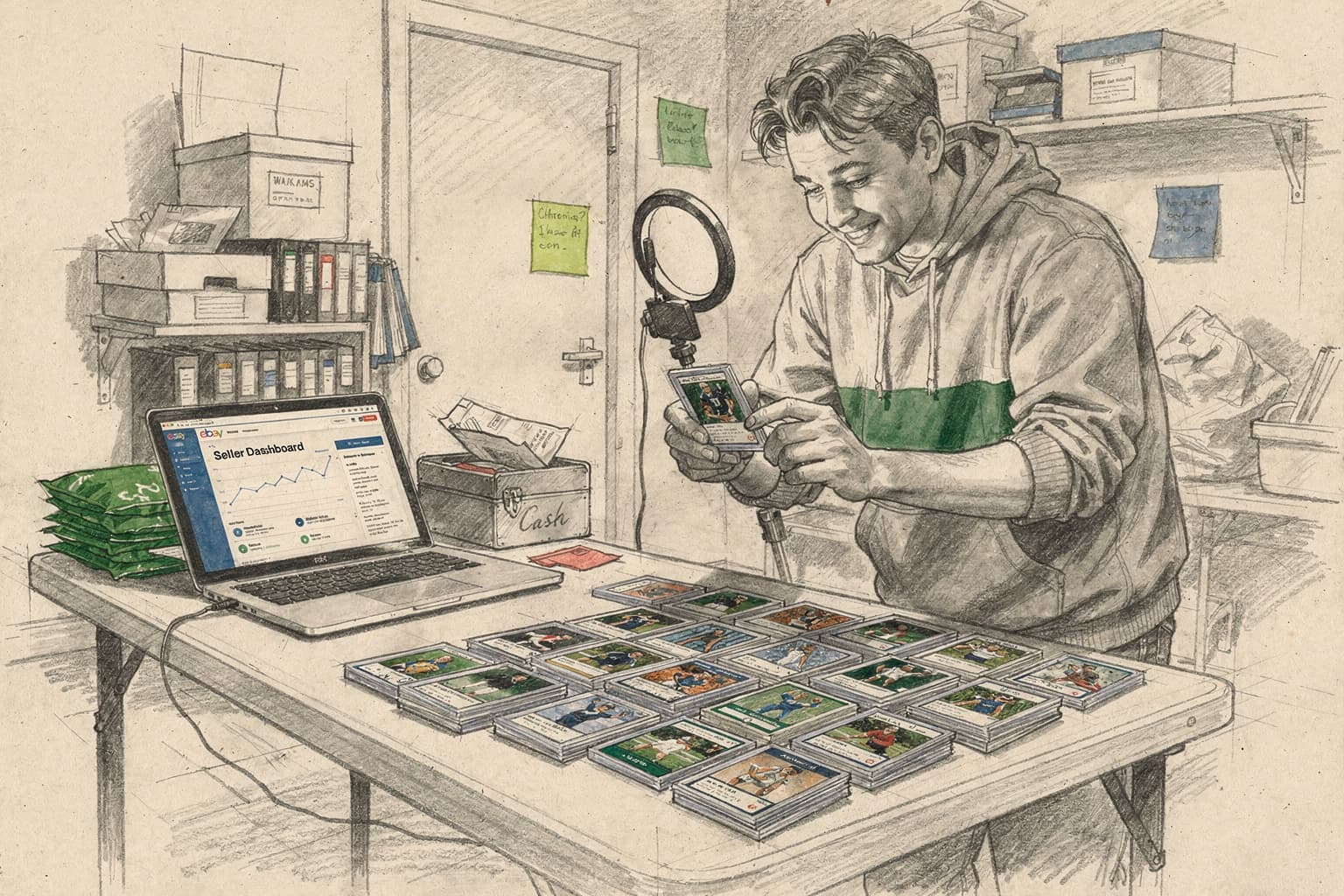
Starting a sports card business sounds like a dream gig, get paid to be in the hobby. And honestly, it can be. But there's a big gap between "I flip a few cards on eBay" and "I run a real card business." The dealers who actually make money long-term treat it like a business from day one: they know their margins, they track their inventory, and they don't let nostalgia override math.
This guide is the playbook. Whether you want to set up at local card shows, run an online storefront, or build a full-time operation, here's how to start a sports card business in 2026 without learning every lesson the hard way.
Is a Sports Card Business Profitable in 2026?
Yes, the sports card market is a multi-billion dollar industry with real margin opportunity, but profitability depends entirely on discipline, niche selection, and knowing your numbers.
The sports card market has settled into a healthier place after the pandemic boom and subsequent correction. The speculators are mostly gone. What's left is a market driven by real collectors, nostalgic buyers, and a growing segment of younger hobbyists entering through Pokemon and basketball.
That's actually good news for dealers. When the hype buyers leave, the people who remain actually want to buy cards, they just want fair prices and a good experience. Margins on graded cards typically run 20-40% depending on your sourcing, and raw card margins can be even higher if you buy well.
The key word is "if you buy well." A sports card business is a margin business. You make money on the buy, not the sell. Every successful dealer will tell you the same thing, inventory acquisition is the entire game.
How Much Money Do You Need to Start?
You can start a viable sports card business with $500-$2,000 in inventory, but expect to reinvest profits aggressively for the first 6-12 months to build meaningful stock.
One of the best things about this business is the low barrier to entry. You don't need a storefront, you don't need employees, and you don't need a massive bankroll. Here's a realistic breakdown:
- Bare minimum ($500): Focus on raw cards, singles under $20, and local selling. You'll need penny sleeves, top loaders, and a way to ship. Start on eBay or at a local show with a single table.
- Comfortable start ($1,000-$2,000): Enough to buy a decent mix of graded and raw inventory, cover a show table rental ($50-$200 at local shows), get basic supplies, and have working capital for restocking.
- Serious launch ($5,000+): Multiple show tables worth of inventory, grading submissions in the pipeline, professional display cases, and marketing materials.
Don't blow your entire budget on inventory. You need money for supplies (sleeves, top loaders, team bags, shipping materials), show table fees, and grading submissions. A good rule of thumb: spend 70% on inventory, 20% on supplies and fees, and keep 10% as a cash reserve.
Choosing Your Niche
Pick one or two niches you actually know well, generalist dealers struggle because they can't price accurately across every category, and bad pricing kills margins.
The biggest mistake new dealers make is trying to sell everything. You see them at shows with a table full of random stuff, vintage baseball mixed with modern basketball mixed with Pokemon, and none of it is priced right because they can't possibly know comps across every category.
Here's how the main niches break down:
- Modern sports (2018-present): High volume, lots of supply, tight margins. You need to move fast and know which rookies are actually selling versus which ones are just being listed. Great for online sales.
- Vintage sports (pre-1980): Higher price points, slower turnover, but better margins. Condition is everything. You need to know grading well. Card show buyers love vintage.
- Pokemon/TCG: Massive market, younger buyer demographic, strong online demand. Sealed product can be very profitable but requires more capital.
- Mid-range graded ($20-$200): This is the sweet spot for many new dealers. Cards are affordable to source, easy to ship, and there's consistent demand. PSA 9s and 10s of popular players in this range move fast.
Whatever you choose, go deep rather than wide. Know every comp, every variant, every price trend in your niche. That knowledge is your actual competitive advantage. A sports card flipping guide can help you understand which niches have the best flip margins right now.
Where to Source Inventory
The best inventory comes from buying collections, hitting card shows early, and building relationships with local sellers, not from buying retail at market price and hoping to resell higher.
Sourcing is everything. Here are the main channels, ranked by margin potential:
Collections and estate sales: This is where the biggest margins live. When someone sells a collection, they usually want quick cash and a single transaction. They're not going to list 500 cards individually on eBay. If you can evaluate a collection quickly and make a fair offer that still leaves you room, this is the best source of inventory. Post on local Facebook groups that you buy collections. Put up a Craigslist ad. Tell everyone you know.
Card shows: Get there early on setup day if the show allows it. Walk the room before it opens and buy from other dealers who are motivated to move inventory. Many dealers will sell to other dealers at wholesale-ish prices, especially on stuff outside their niche. Check our card show setup guide for more on working shows effectively.
Facebook groups: Join every local and national buy/sell group in your niche. People post deals constantly, and the pricing is often below eBay because there are no fees. Speed matters here, good deals go fast.
eBay: Yes, you can source on the same platform you sell on. Use saved searches, watch for misspelled listings, and look for lots where the seller didn't bother to break things out individually. The margin is tighter than other channels, but the volume is there.
Breaks and Whatnot: Buying into breaks can land you cards below market value, but it's essentially gambling. Don't make this a primary sourcing strategy. It's supplemental at best.
The real unlock is building a reputation as the person who buys collections. Once people know you're a buyer, inventory comes to you instead of you chasing it.
How to Price Cards for Resale
Price based on recent sold comps (not active listings), account for platform fees and shipping, and adjust down 10-15% for show pricing where buyers expect deals.
Pricing is where most new dealers leave money on the table, or worse, overpay for inventory because they priced based on active listings instead of actual sales. Here's the framework:
- Check sold comps, not listings. What a card sold for on eBay in the last 30-90 days is the market price. What someone is asking for it means nothing.
- Account for fees. eBay takes roughly 13.25% (which includes payment processing). Whatnot takes a cut. Even at shows, you have table fees. Your selling price minus fees minus what you paid is your actual margin.
- Price for the channel. eBay buyers expect market price. Show buyers expect 10-15% below eBay because they're buying in person and there's no shipping. Adjust accordingly.
- Don't get emotional. If comps say a card is worth $40, it doesn't matter that you think it should be worth $60. The market is the market.
For a deeper dive on show-specific pricing strategy, check out how to price sports cards at a card show. Getting this right is the difference between a profitable show and hauling the same inventory home every weekend.
Selling Channels
Use multiple channels, eBay for volume and reach, card shows for cash flow and relationships, and platforms like Whatnot or a personal storefront for building a brand.
Don't put all your cards in one basket (pun intended). Each channel has strengths:
eBay: Still the biggest market for sports cards. The buyer pool is massive, sold data is transparent, and you can sell 24/7. The downside is fees (roughly 13.25%) and competition. For most dealers, eBay should be your primary online channel.
Card shows: Cash transactions, no fees, instant payment, and you build relationships with repeat customers. The downsides are table costs, travel time, and the fact that you're physically tied to one location. But the cash flow from a good show weekend is hard to beat. Running a smooth operation at shows means having a fast way to look up prices and process sales, a dedicated card show POS system saves you from fumbling with calculators and spreadsheets while buyers are waiting.
Whatnot: Live selling platform that's growing fast. Great for moving volume and building a following. The auction format means you might sell some things below what you'd get on eBay, but the speed and engagement can be worth it.
Your own storefront: Whether it's a Shopify site, a Slabfy online storefront, or even a well-organized Instagram page, having your own presence means no platform fees and direct customer relationships. It takes longer to build traffic, but it's worth it for the long game.
Consignment: Taking cards on consignment from other collectors is a great way to expand your inventory without spending your own capital. You sell their cards, take a percentage, and everyone wins. The key is having good systems to track what belongs to whom.
Tracking Inventory and Managing Your Business
Treat this like a real business from day one, track every purchase, every sale, every fee, and know your actual profit margin on each transaction, not just your gut feeling.
This is where most hobby businesses fail. People buy and sell cards for months, feel like they're making money, and then realize they have no idea if they actually are. Good inventory tracking answers the critical question: am I actually profitable, or am I just moving money around?
At minimum, you need to track:
- Cost basis: What you paid for each card, including any fees or shipping to acquire it
- Selling price: What you actually sold it for
- Fees: Platform fees, shipping costs, show table fees allocated per card
- Profit per card: Selling price minus cost basis minus all fees
A spreadsheet works when you have 50 cards. It falls apart at 500. And it's completely unmanageable at 5,000. This is where purpose-built tools earn their keep. Slabfy's Price Check feature, for example, lets you scan a card at a show and instantly see what it's worth based on real comps, no fumbling through eBay on your phone while a seller waits for your offer.
You also need to register your business properly. Get an EIN, open a business bank account, and keep your personal and business finances separate. Talk to an accountant about whether an LLC makes sense for your situation. This is strongly recommended, it's how you protect yourself and make tax time not horrible.
Scaling with AI Tools
AI tools are changing how dealers price, grade, and make decisions, the ones who adopt early get a real edge on sourcing and selling efficiency.
The sports card business has always rewarded information advantages. Dealers who knew prices better than their competitors could buy smarter and sell faster. AI is amplifying that advantage dramatically.
Here's what's already possible in 2026:
- Automated pricing: Instead of manually checking comps for every card, AI-powered tools can pull recent sales data and give you a market price in seconds. This matters most at shows and when evaluating collections, where speed directly translates to deals.
- Grading predictions: Tools like the Slabfy Grade Ladder analyze the price spread between grades and tell you whether submitting a raw card for grading is actually profitable. If the spread between a PSA 8 and PSA 10 doesn't justify the grading fee and risk, you'll know before you waste the money.
- Portfolio analytics: Knowing what your inventory is actually worth in real time, not what you paid for it, but what the market says it's worth today, lets you make better decisions about what to hold, what to discount, and what to restock.
- Collection evaluation: When someone walks up to your table with a box of cards to sell, being able to quickly scan and evaluate the collection gives you confidence to make offers on the spot. Hesitation loses deals.
The dealers who are winning right now aren't necessarily the ones with the most capital. They're the ones making faster, better-informed decisions. The tools exist, the question is whether you use them.
Common Mistakes New Dealers Make
The top killer of new card businesses is overpaying for inventory based on emotional attachment rather than data, followed closely by ignoring fees and not tracking costs.
Learn from other people's expensive lessons:
Overpaying for inventory. This is the number one margin killer. You see a card you love, you know it books for $100, so you pay $70 thinking you'll make $30. But after eBay fees ($13), shipping ($4-5), and your time, you made $12. On a $70 investment. That's a 17% return that took two weeks. You would have been better off not buying it.
Ignoring platform fees. eBay's 13.25% cut is real money. If you're not building that into your buy price, you're not actually profitable, you just think you are.
Going too wide too fast. You don't need to be the dealer with 10,000 cards across every sport and era. You need to be the dealer who knows their 500 cards cold and can price them in their sleep.
Not tracking cost basis. If you can't tell me exactly what you paid for a card (including shipping, fees, and your share of a lot), you can't tell me if you made money selling it. Period.
Skipping grading math. Sending every card to PSA is not a strategy. Grading makes sense when the price spread between raw and graded justifies the fee, turnaround time, and risk of a low grade. Run the numbers first.
Pricing based on listings instead of sales. Someone listing a card for $200 doesn't mean it's worth $200. Check what it actually sold for. This is the most common pricing mistake in the entire hobby.
Trying to time the market. Holding cards waiting for a price spike is speculation, not a business. Dealers make money on turnover. Cash sitting in inventory that isn't moving is dead capital.
Getting Started Today
Pick a niche, buy $500 worth of inventory you know well, list it on eBay or book a table at a local show, and track every dollar, you'll learn more in 30 days of doing than 6 months of planning.
Analysis paralysis kills more card businesses than bad inventory does. Here's your actual first-week action plan:
- Pick your niche. One sport, one era, one price range. You can always expand later.
- Set a budget. Start with whatever you're comfortable losing, because some of your early buys will be mistakes. That's tuition.
- Buy 20-30 cards. Source from Facebook groups, a local show, or eBay lots. Focus on cards in your niche that you can confidently price.
- List them. eBay is the easiest starting point. Take good photos, write honest descriptions, price based on sold comps.
- Track everything. Even if it's just a spreadsheet for now. Cost, selling price, fees, profit. Every card, every time.
- Book a show table. Find a local card show and pay for a table. Nothing teaches you faster than sitting behind a table for 8 hours talking to buyers.
- Reinvest. Take your profits and buy more inventory. For the first 6 months, growth matters more than income.
The sports card business rewards people who actually do the work. Not the ones who watch YouTube videos about it, not the ones who talk about it in Discord servers, but the ones who buy cards, sell cards, and learn from every transaction.
The Bottom Line
Starting a sports card business in 2026 is more accessible than ever. The tools are better, the market data is more transparent, and the buyer pool is global. But accessible doesn't mean easy. The dealers who thrive are the ones who treat it like a business, tracking costs, knowing their margins, pricing with data instead of feelings, and continuously reinvesting in both inventory and the tools that make them faster.
You don't need a huge bankroll. You don't need a warehouse. You don't need to quit your day job (yet). You need a niche you know well, the discipline to track your numbers, and the willingness to learn from every deal that doesn't go the way you planned.
Start small, stay disciplined, and let the compound effect of smart buying and consistent selling do the heavy lifting. The hobby needs good dealers. Might as well be you.